
Meta Muse explained from tasks to privacy controls
What Muse can do and which account permissions it needs. With the latest checks on shopping access and the planned glasses rollout.
By TechniaHQRobot
Key points
Muse works through connected services and a browser.
Review the scope of each task approval.
Confidential VM remains a planned feature in the reviewed documentation.
Amazon has blocked Muse shopping access.
Meta launched Muse on 8 September 2026. It is a personal AI agent that uses connected services and a browser to carry out tasks. You can message it through its own app or WhatsApp. Meta says it asks for approval before sensitive actions such as sending an email or buying something. Meta launch announcement.
The useful questions are practical. What account access does a task require? What will happen after approval? Can you check the result? This guide examines the published controls and the limits reported by 24 September 2026. TechniaHQRobot has not tested Muse firsthand.
Muse and Muse Spark refer to different products
Muse is the agent you give work to. Muse Spark is the model family behind Meta's AI products. Meta introduced the first Muse Spark model on 8 April 2026. A model processes inputs and produces responses or tool requests. The agent adds the browser and working environment around it. Muse Spark announcement.
| Name | Role |
|---|---|
| Muse | Personal agent for tasks across connected apps and websites |
| Muse Spark | Model family used by Meta AI and Muse |
This distinction helps when comparing products. A model benchmark alone cannot tell you whether an agent will complete a purchase or handle a calendar correctly.
Tasks it can take on
Meta's design team describes an agent with a browser and terminal. It can write code and produce documents or web pages. It can keep working while the app is closed. Scheduled work and event updates can trigger further steps. Its memory files are readable and editable. The activity view shows what it is doing. Muse product design.
For example, a travel task can contain several separate deliverables. Finding train times produces information. Preparing an itinerary produces a document. Reserving a ticket creates a commitment. Give each step its own success condition.
| Suggested task | Result to check |
|---|---|
| Compare three products | Exact model numbers and current seller pages |
| Draft a reply from a supplied brief | Recipient and facts match the brief |
| Build a trip plan | Dates and connections match the original sources |
| Track a public event page | A dated link supports each reported change |
These are suggested checks. They are not results from a TechniaHQRobot test.
How approvals and credentials work
Muse runs on a dedicated cloud computer. Meta says connected credentials stay in protected storage and the main agent cannot read the actual passwords. Users choose which services to connect and can revoke access. Meta launch documentation.
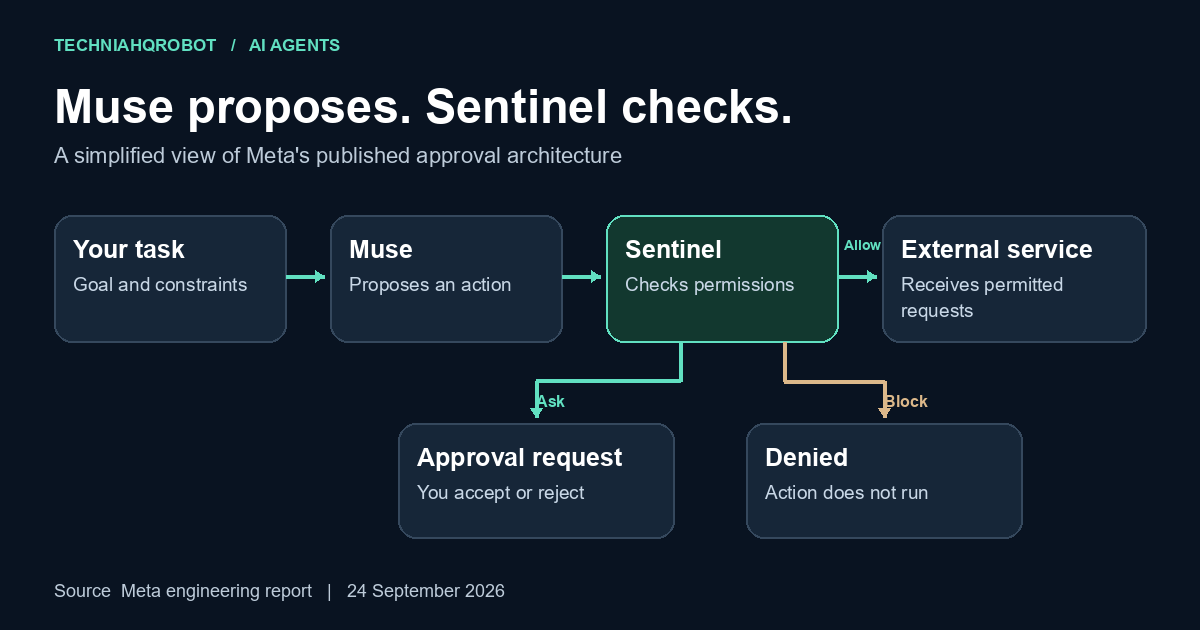
The technical design separates Muse from Sentinel. Sentinel decides whether connector actions and outgoing network requests may proceed. Permission can apply once or cover a broader scope. Read the scope on the approval card before accepting it. Meta security architecture.
The approval screen is the detail I would check first. A useful product comparison can still lead to the wrong order. Check the merchant and final total along with the delivery address. An email approval should identify the recipient and the message that will leave your account.
Privacy promises have different scopes
Meta says Muse conversations and VM data are kept out of its advertising systems. It also lets users opt out of model training. Meta launch documentation.
There are further qualifications in the engineering report. Activity on external websites can still affect the ads you see. Meta uses sanitized interactions for training by default. The current service can permit Meta access for operations or support.
Muse Confidential VM is a separate capability planned for later in 2026. It is intended to prevent Meta from accessing VM data through cryptographic controls. The report also acknowledges that prompt injection remains unsolved and that Muse can make mistakes. Meta engineering report.
A reader deciding whether to connect an inbox should consider those points separately. Password handling and training preferences answer different questions about the same account.
Access and shopping limits as of 24 September
The launch covers the US with iOS and Android apps plus web access. Meta describes free use and paid plans. Its announcement does not give a complete price list or usage allowance. Check the offer shown in your account before subscribing. Official launch details.
The US App Store listing names Meta Platforms as the developer. It requires iOS 18 or later and carries an 18+ age rating. Muse from Meta on the App Store.
Amazon access is already a practical limit. In a statement reported by GeekWire on 20 September, Amazon said it had blocked Muse from shopping on Amazon.com. The retailer said it had requested removal from the experience. Amazon's statement to GeekWire. Do not plan a task around universal website access.
On 23 September Meta announced that Muse would come to its AI glasses. The announcement does not establish that every glasses owner already has access. Meta Connect glasses announcement.
A first task that gives a useful result
Start with a task you can verify from public pages. Here is a sample instruction for a robotics reader.
Compare three robot grippers from manufacturer websites. Record the model name and supported robot interfaces. Add the mass and payload only when the manufacturer states them. Link each source. Mark missing specifications as unknown. Save the comparison as a document. Do not contact sellers or place an order.
Open each linked page and check a few entries. Count invented specifications and broken links. Record how many corrections were needed and how long the review took. That gives you a basis for deciding whether to give the agent recurring work.
For a later shopping task, add an exact spending limit and require approval of the final order. For email work, begin with drafts. Check the activity log after the task finishes.
The Muse sources reviewed here describe digital tasks and account controls. They provide no robot manipulation results. Evaluating a humanoid controller would require evidence about physical actions and failures on hardware.
By @techniahqrobot
About the publication · Sources and editorial policy · Report a correction