
Introduction
Agility Robotics announced Digit 5 on September 15 with a heavier lifting specification and a shorter charging stop. The company lists a repeated lift of 22.7 kg, or 50 lb, plus 90 minutes of operation followed by nine minutes of charging. Those two figures put material handling and shift scheduling at the center of the release.
The design is still in development. Agility says specifications can change and some safety features are still being developed. The release gives a useful engineering target, while a buyer still needs evidence from the exact robot configuration and task.
Information verified from official sources available as of September 15, 2026.
Two charging-cycle calculations
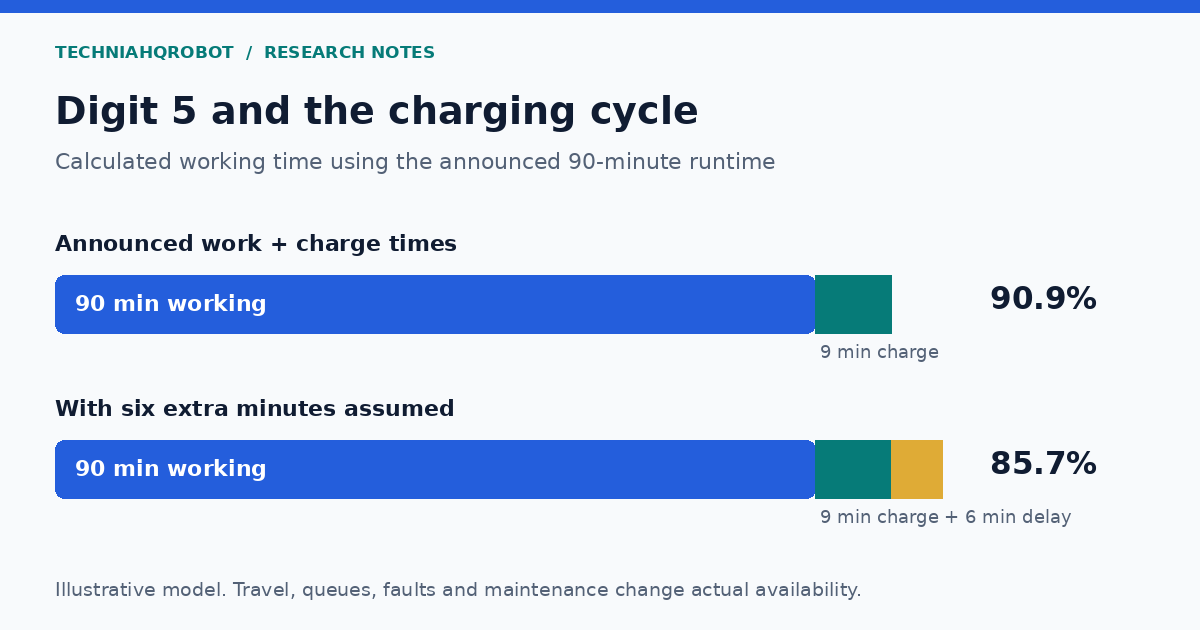
Illustrative calculations from the announced 90-minute runtime. Neither row is a measured availability result.
| Scenario | Work per cycle | Time per cycle | Working fraction |
|---|---|---|---|
| Published work and charge times only | 90 min | 99 min | 90.9% |
| Assumed six additional minutes per cycle | 90 min | 105 min | 85.7% |
Source for runtime and charge time is Agility Robotics. Additional delay and calculations are TechniaHQRobot analysis.
The load includes the handling task
Agility lists a height of 1.81 m, a mass of 129 kg and a maximum reach of 2.2 m. The repeated lifting specification is 40 percent above Digit 4. New legs use cycloidal actuators, and an ISO mounting flange supports changes of gripper.
For a warehouse, the 50 lb figure needs to be read alongside the object shape, grip, reach and lift path. A compact tote held close to the body presents a different loading case from a long part lifted at full extension. A purchasing trial should specify both the weight and its position through the complete motion.
Changing grippers also changes the task setup. The useful acceptance record includes tool mass, grip loss, successful placement and the time spent recovering a dropped or misplaced item. Counting completed transfers gives a clearer operating measure than counting lifts alone.
A charging ratio is only one part of availability
The published cycle yields an ideal working fraction of 90 divided by 99 minutes, or about 90.9 percent. Repeating that cycle for 24 hours gives approximately 21.8 hours of operation. This is our arithmetic using Agility's figures, with no allowance for travel to the charger, queues, setup, faults or maintenance.
An extra six minutes around each charging stop would reduce that modeled fraction to 85.7 percent. The example is a scheduling assumption, not a measurement of Digit 5. It shows why charger placement and fleet coordination belong in a trial plan.
A site should measure completed transfers per paid shift and the minutes of human assistance needed to achieve them. A fast recharge helps only when the robot can resume useful work and the rest of the process is ready.
Safety claims need a defined operating case
Agility describes an independent safety controller, sensing of nearby people and responses that can include avoiding, stopping or sitting down. It also names NVIDIA IGX Thor and Halos for Robotics in the development effort.
Those statements do not establish that every intended task has been validated for shared workspaces. Ask for the released safety functions, stopping behavior, permitted operating conditions and application assessment. A demonstration of a controlled stop gives evidence about that event; a deployment needs the behavior to hold across its foreseeable conditions.
The practical next milestone is a documented customer task with payload, cycle time, charger use and interventions reported together. That would let operators compare Digit 5 with their current method using the same work definition.
Limitations and missing information
- Digit 5 remains in development. Published specifications and safety features are subject to change.
Sources and methodology
Share this article
Share the current TechniaHQRobot article page.
Continue reading
Open the latest robotics reporting, Physical AI analysis and hardware notes.