
Introduction
Dynin-Robotics brings language, visual observations and robot actions into one diffusion model. The September 11 paper from Seoul National University's AIDAS Lab reports tests on a Franka Research 3 arm, alongside simulation benchmarks. Its four-task hardware average is 78.4 percent.
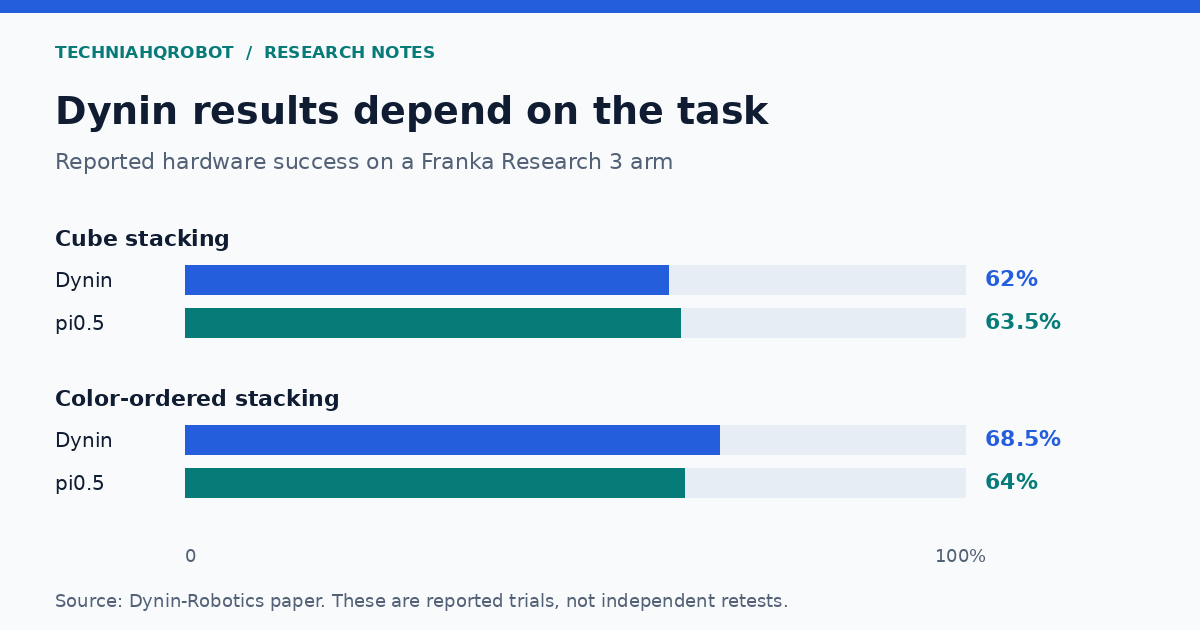
The individual results are more informative than the headline average. The model improves on pi0.5 for color-ordered stacking, but falls behind it on ordinary stacking. That makes this a useful study of task differences within robot manipulation.
Information verified from official sources available as of September 15, 2026.
Original X post
Open on XLoading the full X post…
Hardware task success reported in the paper
| Policy | Cube stacking | Color-ordered stacking | Four-task average |
|---|---|---|---|
| Dynin-Robotics | 62.0% | 68.5% | 78.4% |
| pi0.5 | 63.5% | 64.0% | 76.9% |
| Cosmos Policy | 67.5% | 42.0% | 73.6% |
The average also includes fruit pick-and-place and cube sorting. Values are the authors' reported test results, not TechniaHQRobot hardware tests.
One token space for observation and action
The model represents language, images, actions, goals and predicted observations with discrete tokens. Masked diffusion fills in the requested parts of a sequence. During learning, different query types ask the same model to produce actions or other information rather than assigning every output to a separate model.
The authors report continued pretraining on 1.33 million trajectories from 48 Open X-Embodiment datasets. The project also describes accelerated decoding. Its reported maximum speedup of 29.2 times is an implementation comparison, not a claim that the physical robot completes a task 29.2 times faster.
For a control system, the relevant delay runs from acquiring an observation to sending a usable command. Camera capture, preprocessing, model inference, communication and controller execution all contribute. A decoder benchmark is useful when its hardware and batch settings are specified, but it covers only part of that path.
Ordered stacking changes the comparison
The paper reports 68.5 percent for Dynin on color-ordered stacking, against 64.0 for pi0.5. On ordinary cube stacking, the corresponding figures are 62.0 and 63.5 percent. Dynin's four-task average leads the listed comparison, while Cosmos Policy has the higher ordinary stacking result at 67.5 percent.
The ordered task asks the system to combine object selection with the physical placement. An improvement there can be useful even if another controller is better at stacking alone. It would be a mistake to apply the aggregate ranking to every manipulation job.
The average advantage over pi0.5 is 1.5 percentage points. That subtraction describes this test set. It does not establish the probability that Dynin will outperform it on a new factory task. Trial counts, variation between runs and the cost of each failure matter when deciding whether a small difference is operationally useful.
What a developer can check next
As of September 15, the linked repository says code and models will be released soon. Readers should check the release itself before treating the work as a downloadable policy. This article describes the published research.
A replication should keep the arm, gripper, camera placement and task definitions consistent, then repeat trials with recorded starting conditions. Changing one condition at a time makes it possible to identify whether a failure comes from perception, selecting an object or contact during placement.
The published hardware results concern a fixed arm. Applying the approach to a walking humanoid would add balance, whole-body coordination and motion-dependent camera views. Those need their own tests. The present result supports a narrower conclusion about the evaluated manipulation tasks.
Limitations and missing information
- A laboratory benchmark does not establish performance on an unseen robot or task.
Sources and methodology
Share this article
Share the current TechniaHQRobot article page.
Continue reading
Open the latest robotics reporting, Physical AI analysis and hardware notes.