
Introduction
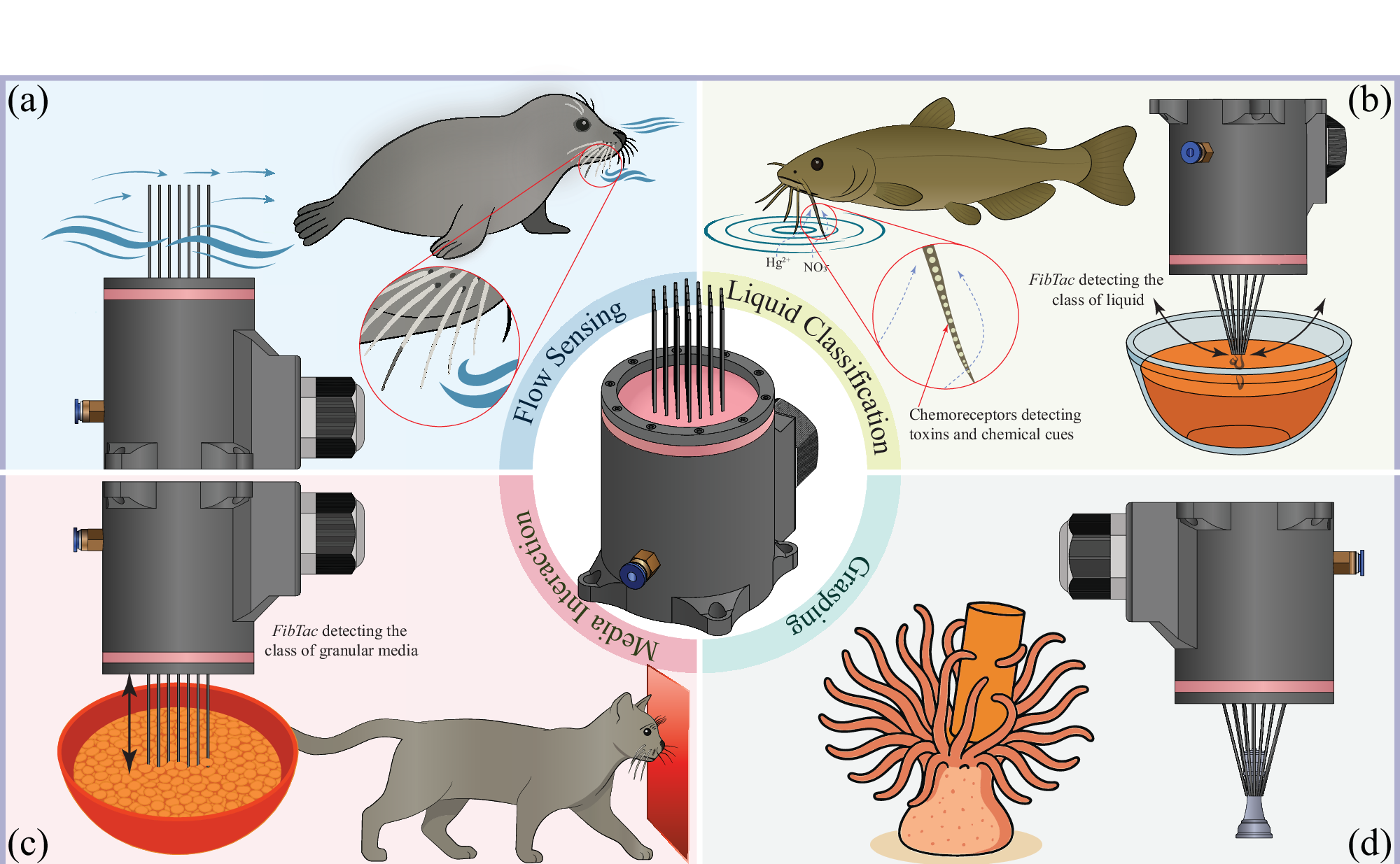
FibTac is a soft pneumatic gripper built around fibers embedded in silicone. An internal camera tracks how the fiber tips move while the same structure bends around an object.
The paper reports a payload up to 186 grams and more than 3,000 actuation cycles without observable damage in the reported durability test. Sensing tasks include liquid classification, object recognition, granular media classification and underwater flow estimation.
Information verified from official sources available as of September 26, 2026.
Sensing comes from deformation of the gripper
Many tactile systems add a separate sensing surface to a gripper. FibTac reads motion in the elements that are already touching and grasping the environment.
Each contact produces a mechanical signal that can be used for manipulation and perception.
The object set includes difficult materials
The authors show thin strands, soft items, biological specimens and granular materials. They report about 97.7 percent overall grasping success in the tested set.
The paper also reports accuracy around 90 percent across several perception tasks. Those values should stay tied to the stated test conditions.
Durability is the deployment question
Soft fibers can reach objects that rigid fingers handle poorly. Long-term use adds abrasion, contamination and calibration drift.
The authors report more than 3,000 actuation cycles without observable damage. That is laboratory durability evidence, while longer field use still needs data on abrasion, contamination, calibration drift and sensing accuracy after wear.
Limitations and missing information
- The results come from the authors' laboratory test set.
- The paper reports more than 3,000 actuation cycles without observable damage, but this does not establish field lifetime under contamination, abrasion or repeated industrial use.
Conclusion
FibTac shows how one compliant structure can both touch an object and generate the signal used to classify that contact.
Sources and methodology
Share this article
Share the current TechniaHQRobot article page.
Continue reading
Open the latest robotics reporting, Physical AI analysis and hardware notes.