
Introduction
A robot pulling a door needs to keep some contact forces and resist others. The handle pushes back against the gripper as the door opens. A shove against the body can produce a similar force magnitude while requiring a different response. A useful contact representation has to retain the location, direction and timing of the load.
FWBC-VLA, submitted in September 2026, studies this problem on a wheeled-legged robot with an arm. Its results belong to that platform and the reported tasks. Applying the same approach to a biped introduces another set of balance and support-contact tests.
What the researchers built
The framework estimates contact from the robot's internal signals. HSR-Force uses residual joint torque to infer contact strength and how it changes over time. Those estimates enter the VLA action expert as tokens. A separate compensation generator combines proprioception, estimated contact state and a body-frame force estimate before a whole-body controller executes the combined command.
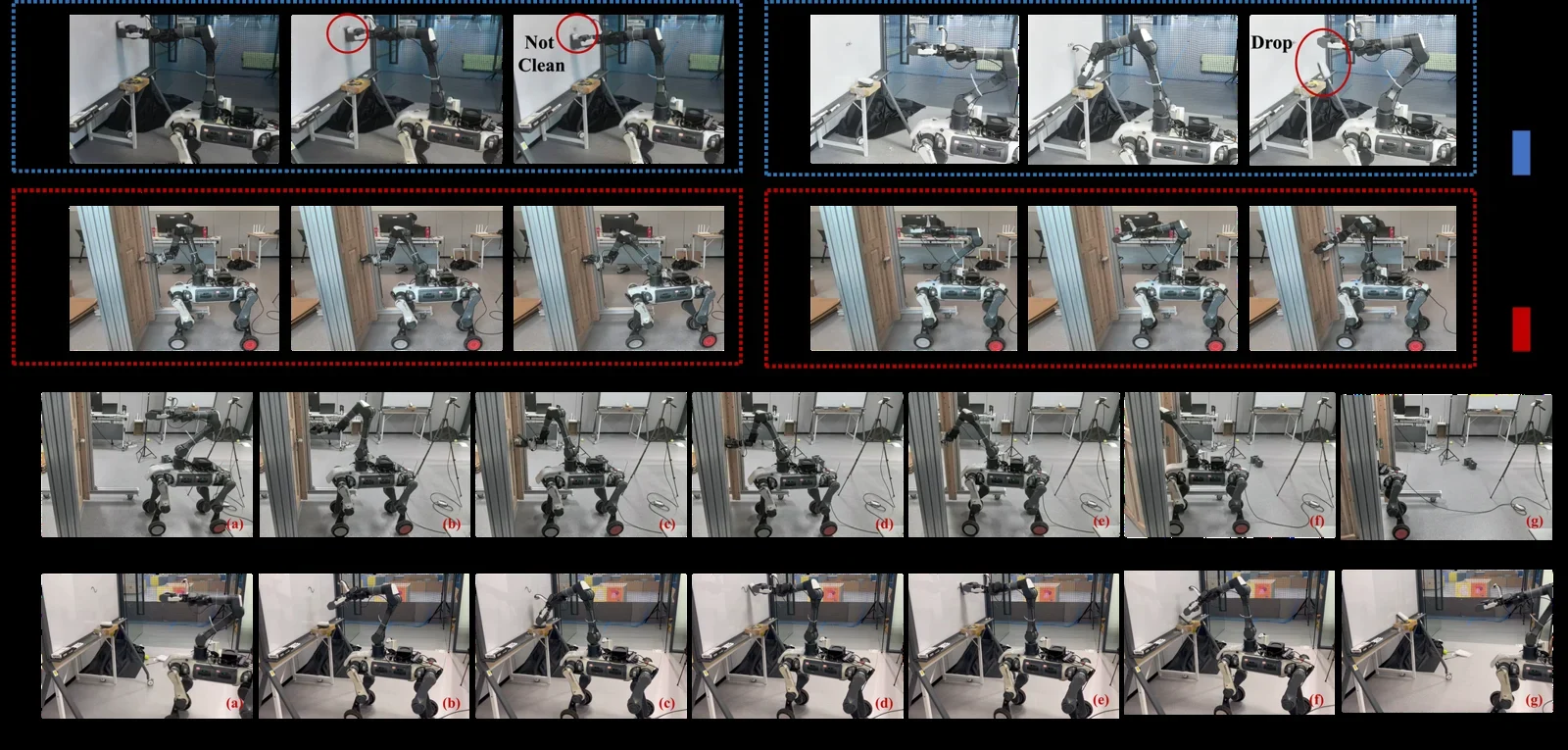
The physical platform is a DeepRobotics M20S wheeled-legged quadruped with a six-joint CM1 arm. The authors evaluate whiteboard wiping and door opening. In the door-with-closer task, FWBC-VLA reaches 52 percent at the final crossing stage, compared with 12 percent for ForceVLA in the reported protocol. These are author-reported results; TechniaHQRobot has not rerun the system.
Why one force number loses information
Consider an illustrative pair of 20 N loads. One acts at the hand. The other acts against the torso. Their effects depend on their directions and distances from the body's support contacts. Even two equal forces on the hand can imply different actions when the robot is pulling a handle, holding position or releasing an object.
A controller can also confuse a desired reaction with a disturbance. During wiping, reducing every contact force would remove the pressure needed to clean the surface. During a collision, maintaining pressure could prolong unwanted contact. The task state and the contact location need to remain connected through the control stack.
A force-attribution test worth reporting
An additional evaluation could hold the commanded task constant while varying where a measured external load enters the robot. Test the gripper, forearm and body separately, then include simultaneous contacts. Use instrumented loading within the platform's approved limits. This is a proposed evaluation, not a test reported as completed here.
For each trial, record the estimated source of contact, force-estimation error, body displacement, task completion and any operator intervention. A confusion table would show whether a body disturbance is repeatedly interpreted as hand contact. The score should keep those mistakes visible even when the robot eventually completes the task.
Separating estimation from compensation
A better completion rate can come from several changes. The estimator might detect contact sooner. The action policy might choose a different arm motion. The whole-body controller might accept a larger displacement. Comparing only the final success rate hides these mechanisms.
A useful ablation holds the task policy and controller settings constant while changing one force input at a time. Record the time from physical contact to the first corrective command. Keep the failed attempts, including trials where compensation stabilizes the body but loses the handle. A recovered stance and a completed manipulation are separate outcomes.
What changes on a humanoid
A biped may transfer weight between feet while its hand remains in contact with the environment. The arm load, foot contacts and support geometry then change together. A wheeled-legged result gives researchers a method to investigate, but does not supply a humanoid success rate.
For a humanoid deployment, the evidence should include the same task at different arm reaches, support stances and payloads. Reports should state whether the robot needed a harness, external tracking or an operator. Those details determine how much of the result carries into a different workspace.
Sources and methodology
Research analysis based on the linked paper and project material. The force-attribution evaluation proposed in this article is an editorial suggestion.
Share this article
Share the current TechniaHQRobot article page.
Continue reading
Open the latest robotics reporting, Physical AI analysis and hardware notes.