
Introduction
Reaching for a moving target requires the robot to revise a movement after it has started. Its next plan must begin from the body pose it actually reached. A reference trajectory based on an earlier pose can become less useful as tracking errors accumulate.
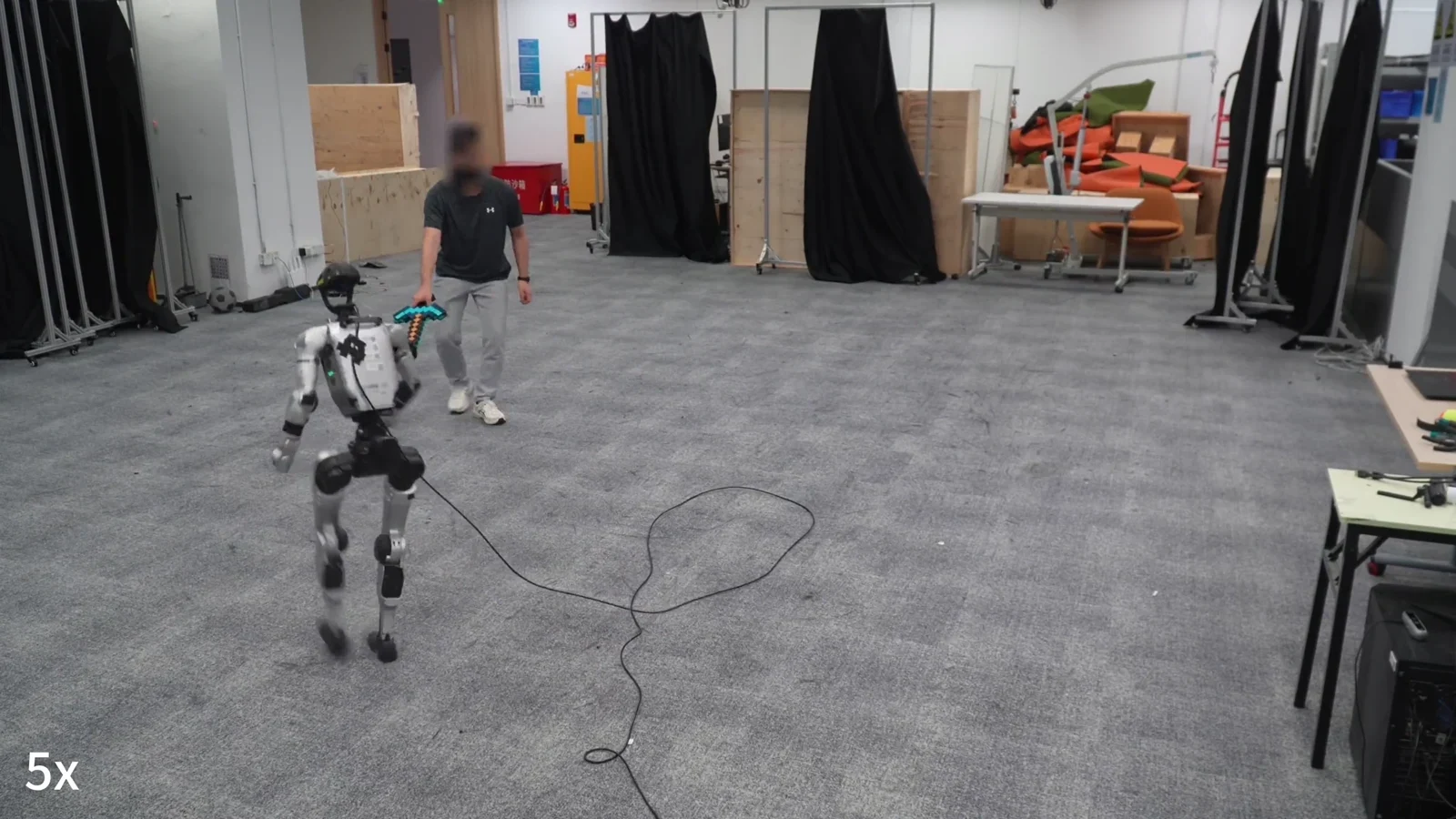
ReactiveBFM studies that feedback loop on the Unitree G1. The project shows online target reaching, changes to text-conditioned motion and recovery after disturbances. Reading those examples alongside the evaluation conditions gives a more useful picture of the controller than a collection of successful movements alone.
Planning from an imperfect body state
The authors train the motion planner with a scheduled prefix-sampling curriculum. The aim is to expose it to imperfect physical states rather than relying only on reference motion. An asynchronous replanning mechanism connects the slower planning process to the faster tracking process.
The project describes a closed-loop planning and control framework. The planner can revise the future motion as observations change. This differs from evaluating only whether a tracker can reproduce a fixed motion from its expected starting state.
What the physical examples show
The Unitree G1 experiments include reaching toward a moving target and recovering from disturbances. The authors describe moving-target reaching as zero-shot transfer from training on static targets. Their project page also presents streaming text commands and several motion categories.
These examples provide evidence about the motions shown under the authors' setup. The published 93.1 percent success figure is a sim-to-sim result under perturbations. It should keep that simulation label wherever it appears, including a headline, image caption or comparison table. It is not a measured household-task completion rate.
A moving target adds several separate tests
A target can move farther away, change direction, become occluded or leave the reachable workspace. A controller may handle one of these cases and fail on another. A useful result therefore specifies the target trajectory, its speed, the starting hand position and the robot's allowed foot motion.
The end of a reach also needs a definition. Touching a target once differs from maintaining contact while it moves. A body that reaches the target after stepping outside the permitted region may satisfy one detector and fail the application. The target detector, workspace boundary and stopping condition should be documented together.
Recovery should preserve the task
Remaining upright after a disturbance is one outcome. Resuming the requested movement is another. A controller can regain balance while forgetting which hand was meant to reach, switching the target or continuing the wrong motion category.
An additional evaluation could log the disturbance time, the first updated plan, foot displacement and the time to return to the requested task. It should include interrupted trials and operator resets. This proposed measurement separates balance recovery from command retention without assuming they improve together.
A sequence of commands also needs a policy for cancellation. When a new instruction arrives during a reach, the system must decide which parts of the existing movement remain committed. Tests should distinguish an instruction accepted by the language interface from a change that has reached the physical controller.
The evidence needed for another robot
Porting the approach to a different humanoid changes joint limits, reach, inertial properties, sensing delay and contact behavior. A planner trained around one body's feasible movements cannot be assumed to preserve the same behavior after a hardware swap.
A reproducible report should identify the robot configuration, control rates, observation sources, policy checkpoint, tracking equipment and any supporting harness. Keep simulation trials and physical trials in separate tables. Add counts of falls, completed reaches and manual resets to the physical table.
For practical use, the next evidence would be repeated runs across target paths and support conditions that were fixed before evaluation. That would let another team compare its own controller against the same task instead of trying to infer performance from edited footage.
Sources and methodology
Analysis of the authors' paper and project page. Suggested reporting fields are editorial proposals. No independent physical trial was performed for this article.
Share this article
Share the current TechniaHQRobot article page.
Continue reading
Open the latest robotics reporting, Physical AI analysis and hardware notes.