
Introduction
A robot arm keeps moving while a vision-language-action model calculates its next commands. By the time the answer arrives, the arm has left the pose shown in the input image. Starting the new trajectory from that old pose can produce a jump in the commanded motion.
Real-time chunking, or RTC, addresses the handoff between those command sequences. It is useful to separate this execution problem from the model's ability to recognize objects or understand the instruction. A policy can choose the right task and still produce a poor handoff.
The commands already in motion
Physical Intelligence's June 2025 RTC work generates the next action chunk while the current one executes. It fixes the portion corresponding to already committed actions and predicts the remaining motion around that constraint. The method applies inference-time conditioning to diffusion and flow policies.
The team's public account describes precise tasks including inserting an Ethernet cable and lighting a candle with a match. Its latency examples total 139 ms for a mobile setup and 108 ms for a static setup. These numbers include preprocessing and transport as well as model computation. They describe the reported configurations, rather than a universal RTC latency.
Why averaging two trajectories can go wrong
Imagine two valid approaches around an obstacle. One passes to the left and the other to the right. Averaging their positions can put the resulting path through the obstacle. A smooth numerical signal does not by itself establish a valid physical trajectory.
The same issue appears when the model switches its intended grasp or changes the direction of a wrist movement. Continuity needs to preserve the actions that will occur before the new result arrives. It also needs to leave room to respond to a changed observation. That balance depends on the command horizon and measured delay.
The training-time follow-up
A December 2025 follow-up moves action-prefix conditioning into training. The authors simulate inference delay and train the policy to condition directly on committed actions. This removes the extra inference-time inpainting calculation used by the earlier approach.
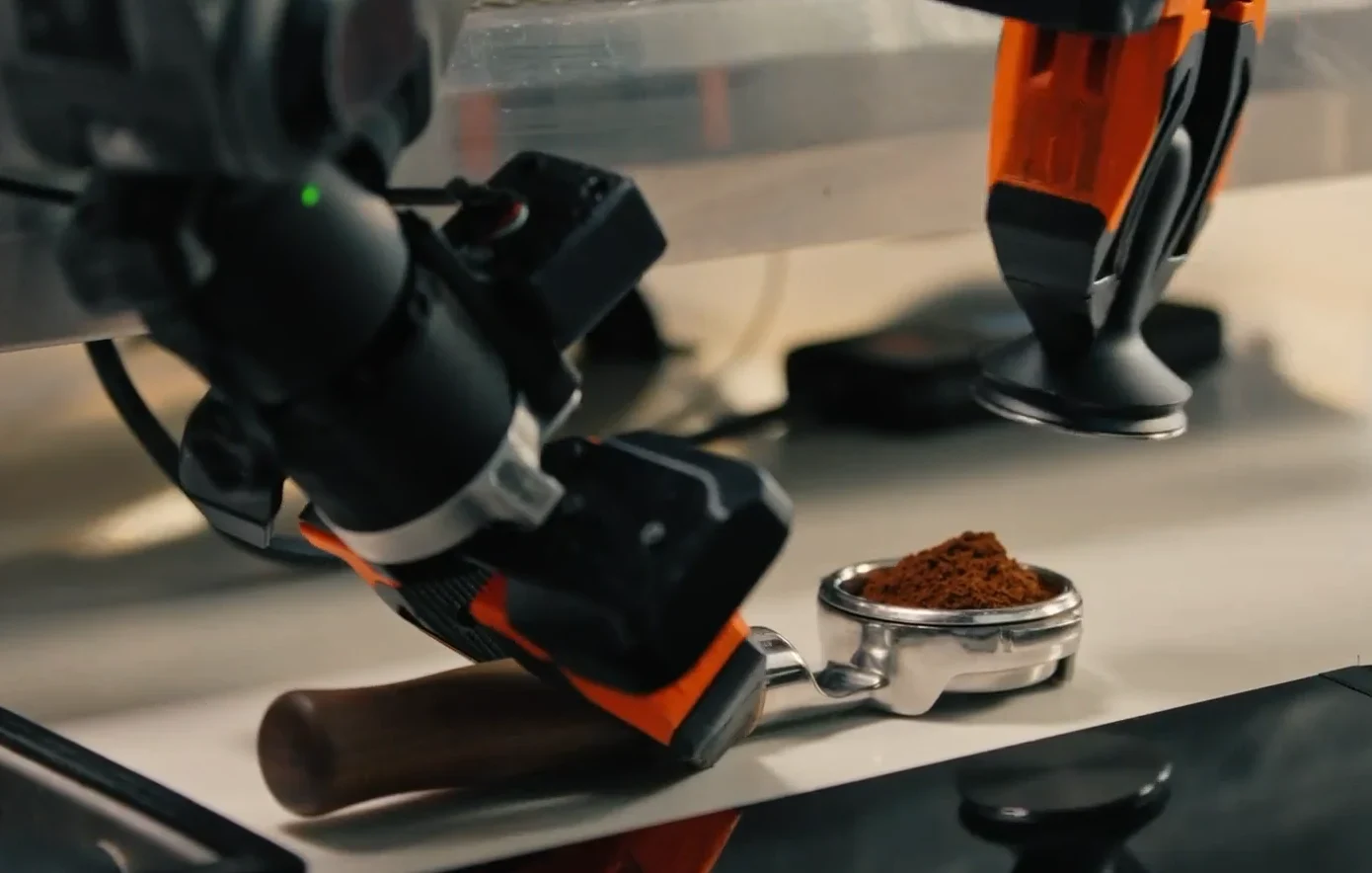
The paper evaluates box building and espresso preparation with a pi-0.6 policy. It reports comparable task performance and speed to inference-time RTC with lower computational cost in those experiments. The method still requires a policy trained or fine-tuned with the appropriate conditioning. It does not remove camera, network or actuator delay.
Measure the age of the command
A deployment report should start the clock when the observation is captured and stop it when the matching command begins execution. Timing only the model call leaves out frame transfer, image processing, queues and controller scheduling. Those omitted stages can determine whether a command is still relevant.
For an illustrative 50 Hz controller, each control interval lasts 20 ms. A 100 ms delay spans five intervals. This arithmetic does not tell us whether a task will succeed. It tells us how much of the earlier sequence may execute before a new result can be used. A runtime must also handle delay variation, rather than assuming every call lasts exactly 100 ms.
Report useful work and failed handoffs
Compare execution methods using the same policy checkpoint, robot, task setup and stop conditions. Publish completion counts, elapsed time and the number of interrupted attempts. Include the distribution of end-to-end delay and the largest command discontinuities at chunk boundaries.
A fast failed grasp should remain a failed grasp in the report. Likewise, a run that finishes after an operator repositions the object needs an intervention label. These records help distinguish shorter idle periods from better task execution.
On a humanoid, whole-body balance may run through a separate controller. RTC in the manipulation policy does not establish a stopping-distance guarantee or a fall-recovery capability. Those behaviors require their own measurements with the actual body, payload and controller.
Sources and methodology
Analysis of the two linked RTC studies. The 50 Hz timing example is an illustrative calculation, not a measured robot result.
Share this article
Share the current TechniaHQRobot article page.
Continue reading
Open the latest robotics reporting, Physical AI analysis and hardware notes.