
Introduction
A September 14 preprint introduces ResSafe, a learned correction layer for humanoid motion control. The work tests whether a separate policy can help a Unitree G1 keep its balance while preserving the movement requested by a reference controller.
The physical tests are small and varied. Reading the four hardware conditions together gives a more useful account than treating a successful video as evidence of guaranteed safety.
Information verified from official sources available as of September 15, 2026.
Falls across four reported hardware conditions
Our sums of Table 3. Each condition contains ten trials. This pooling is descriptive and is not a deployment forecast.
| Controller | Falls / trials | Calculated share |
|---|---|---|
| Original baseline | 33 / 40 | 82.5% |
| Payload-randomized baseline | 9 / 40 | 22.5% |
| ResSafe | 3 / 40 | 7.5% |
A lower pooled value can hide an unfavorable result for an individual motion. The article discusses that exception.
Correct the command while preserving the task
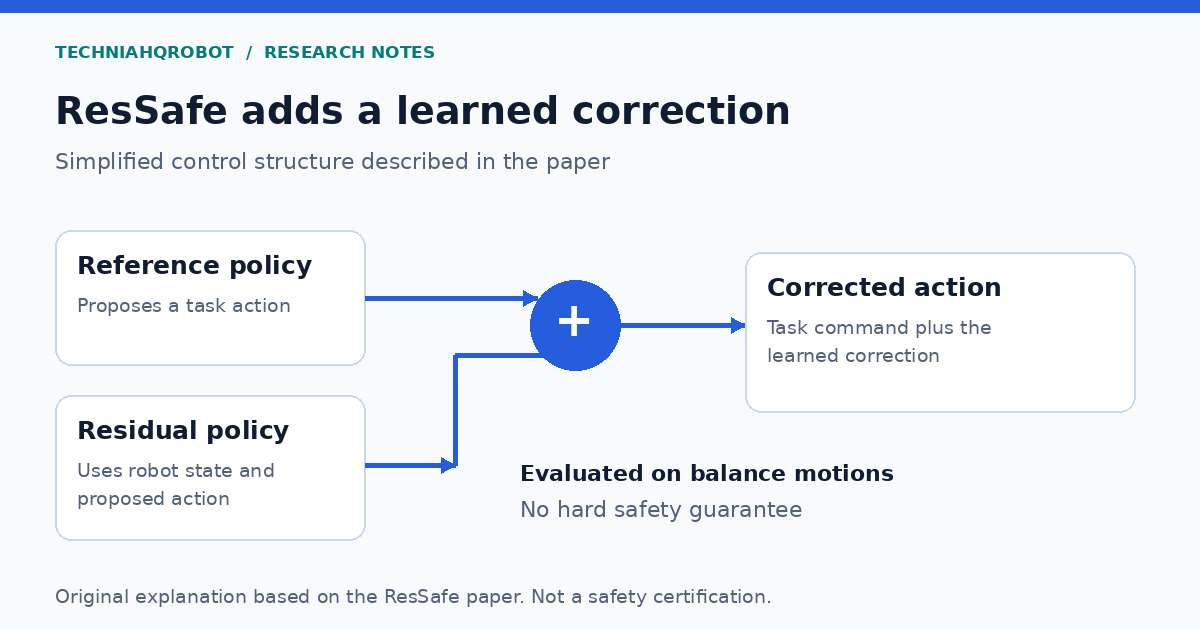
The reference policy proposes an action. A residual policy observes robot state information and that proposed action, then adds a correction. Training rewards survival while penalizing unnecessary changes. The paper uses simulation training and tests the resulting policies on hardware.
This arrangement creates two questions for evaluation. Does the robot fall less often? How much does the correction change the movement it was asked to perform? A controller could stay upright by barely attempting a difficult motion. Measuring task tracking alongside falls helps expose that tradeoff.
A useful comparison would therefore keep the requested movement fixed and record the complete trajectory. It should show when the correction activates, how large it becomes and whether the robot returns to the requested behavior afterward. Those records would help an operator distinguish brief recovery from persistent loss of task performance.
The hardware result varies by motion
Table 3 reports ten trials in each of four conditions. Adding the reported falls gives 3 out of 40 for ResSafe, 9 out of 40 for the payload-randomized baseline and 33 out of 40 for the original baseline. The conditions include different motions with and without attached payloads.
The pooled rates are therefore 7.5, 22.5 and 82.5 percent. These are our calculations across the four reported conditions. They give equal weight to each condition and should not be read as expected fall rates during deployment.
ResSafe is not best in every row. In motion 9350 with a payload, it falls twice in ten trials while the payload-randomized baseline records no falls. The second baseline also has lower tracking error in that condition.
That exception matters when selecting a controller. If a planned job resembles one particular motion, its result may matter more than an average across the other three. Ten attempts also provide limited evidence about rare failures. Repeating a trial under the actual load distribution would be necessary before drawing a stronger operating conclusion.
A learned filter has a defined scope
The authors explicitly say the method has no hard safety guarantee. They also identify limited motion generalization, simulation-to-hardware differences and the absence of external perception in the filter.
Balance is one part of safe operation. A robot can stay upright while making an unsafe contact, damaging an object or blocking a person. A controller evaluated on falls therefore needs additional evidence before it can support claims about an entire application.
For engineering review, keep separate records for task completion, falls, contact events and human recovery. Define stop conditions before trials and identify which layer handles them. ResSafe offers a research result about learned balance correction; the published tests leave the wider application assessment open.
Sources and methodology
Share this article
Share the current TechniaHQRobot article page.
Continue reading
Open the latest robotics reporting, Physical AI analysis and hardware notes.