
Introduction
Robocurve announced a $10 million seed round on September 14 to expand its work evaluating how AI models control robots. Initialized Capital led the round. The company plans to grow its research team, test more tasks and hardware, and support open benchmarks.
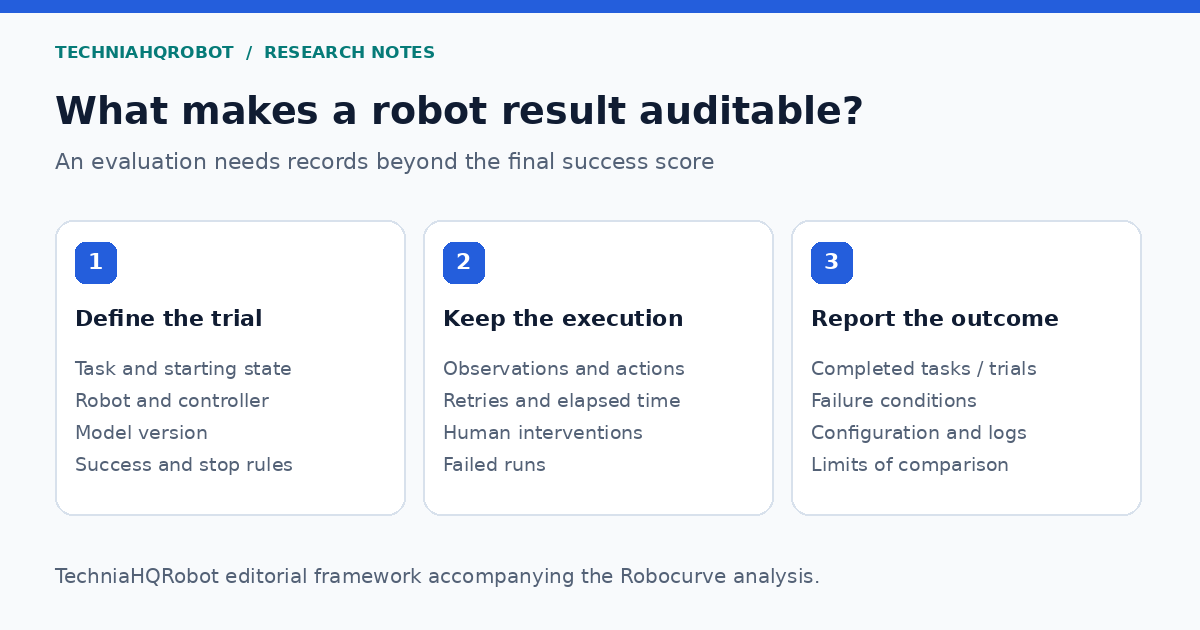
The useful question for robotics teams is what an evaluation exposes about a system. A score becomes actionable when another team can identify the robot, controller, starting conditions, grading rule and failures that produced it.
Information verified from official sources available as of September 15, 2026.
Original X post
Open on XLoading the full X post…
Independent evaluation needs inspectable methods
Robocurve describes itself as a public benefit corporation and says frontier model developers do not direct its evaluation methods or control its published results. These are the company's stated commitments.
A reader can assess those commitments by looking at the method attached to each result. Who chooses the task? Which model version is used? Are failed runs retained? Can an outside team reproduce the starting conditions and grading? Publishing answers to those questions makes an independence claim easier to evaluate.
A financial relationship does not by itself answer whether a comparison is sound. The report needs enough detail to show how decisions were made, including any access or support supplied by a model provider.
Inspect Robots records more than a final score
The project's MIT-licensed Inspect Robots repository describes a common framework for running policies against compatible robots or simulators. It supports LLM agents and vision-language-action policies, with records that include grading scores, model transcripts and configuration. Rerun visualization helps inspect the resulting execution.
A reusable task definition makes it possible to compare controllers without quietly changing what counts as success. Compatibility still matters. A shared software interface does not make two arms equivalent in reach, gripper geometry, sensing or control frequency.
For example, suppose two systems each finish eight of ten placements. One may require several retries and a minute of model calls per placement. The other may finish in a single attempt. The headline completion figure is identical, while the operational cost differs. This is an illustrative example, not a Robocurve result.
Keeping intervention counts, retry limits and elapsed time alongside completion makes that distinction visible. Retaining failed traces can also reveal recurring causes such as missed grasps or an object leaving the camera view.
A benchmark must match the intended use
Robocurve's announcement acknowledges uncertainty about extending model competency to hands and whole-body humanoid control. Simple arm tasks do not resolve that question.
A team selecting a policy should first write down the physical job and its constraints. A benchmark of tabletop sorting can help with object selection and placement. It says much less about walking while carrying a load, reacting to nearby people or recovering from a hardware fault.
The strongest use of an open evaluation framework is to make a specific comparison repeatable. Funding can support a larger set of trials. The evidence still comes from the published tasks and records, so future releases should be judged on those details.
Sources and methodology
Share this article
Share the current TechniaHQRobot article page.
Continue reading
Open the latest robotics reporting, Physical AI analysis and hardware notes.