
Introduction
RobotPlusPlus is directing its Series C funding toward international expansion and embodied AI. Its September 15 announcement describes a round of several hundred million renminbi, without an exact amount. The company builds machines for maintenance work at height, including robots that prepare steel surfaces in shipyards and industrial facilities.
The announcement raises a practical question for Physical AI: how much useful work can a specialized machine complete in the environment it was built for? For a wall-climbing robot, that depends on access to the surface, attachment, tool contact and the work required after the machine has passed.
Information verified from official sources available as of September 15, 2026.
Three measures for an industrial maintenance trial
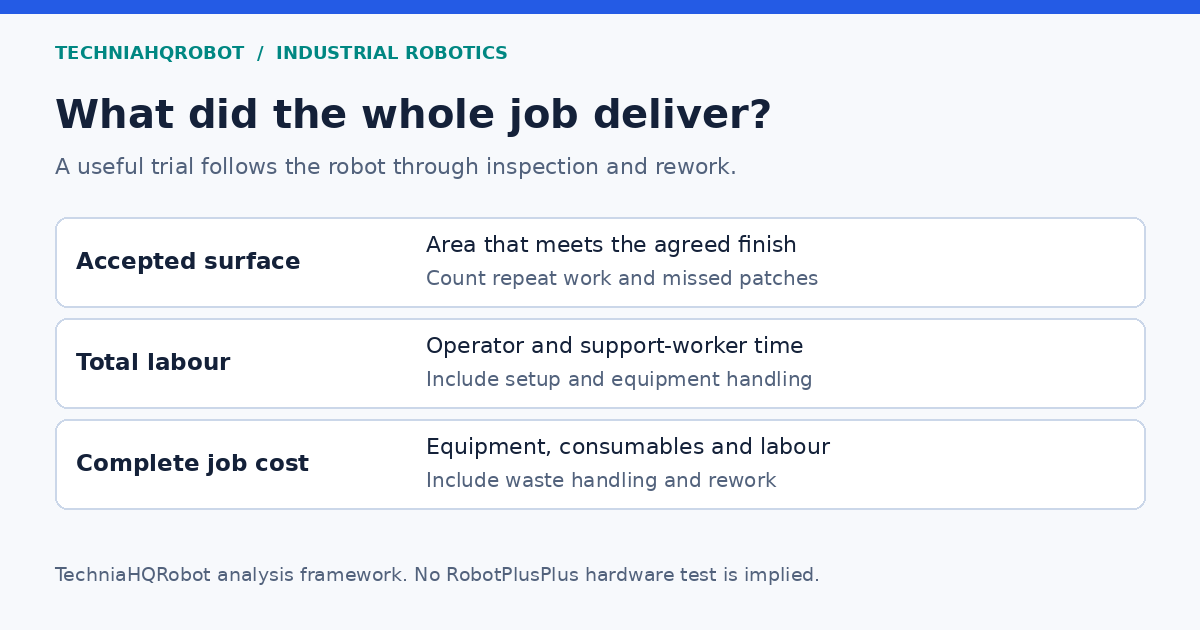
An editorial framework for comparing a robotic process with the existing method.
| Measure | Record | Why it matters |
|---|---|---|
| Accepted surface area | Area passing the agreed inspection, including rework | Connects throughput to a usable result |
| Total labour | Time contributed by every operator and support worker | Makes assistance visible |
| Complete job cost | Setup, equipment, consumables, waste handling and rework | Supports a like-for-like cost comparison |
Proposed by TechniaHQRobot. This is not a test result or a performance claim from RobotPlusPlus.
The funding has an earlier paper trail
The September release names Qianggang Capital Fund as lead investor, alongside GIG Capital Group, Sealand Innovation and Juntong Capital, with further investment from Fosun RZ Capital. These are details supplied by RobotPlusPlus.
There is also an earlier primary record. On August 5, law firm AnJie Broad reported that it had advised RobotPlusPlus on a completed Series C of several hundred million renminbi, naming overlapping investors. The September publication date should therefore not be read as proof that a second round closed that day. The two announcements do not provide enough detail to establish separate transactions.
A steel wall defines the operating envelope
RobotPlusPlus describes permanent-magnet attachment for its HighMate hydroblasting machines. The product documentation lists ground-based remote control, several automation modes and fall-arrest equipment. Magnetic attachment also limits where the machine can work: the surface must support the specified method of adhesion.
The HighMate AP platform uses interchangeable modules for jobs such as abrasive blasting, coating and water-jet cleaning. Its documentation describes a 2.5-metre minimum adaptable curvature and an optional automatic-navigation upgrade. Those details are more useful for selecting a machine than treating every product as fully autonomous.
A tank inspection should map the actual route before a trial: seams, pipes, transitions and inaccessible patches can change how much of the job the robot completes. A successful pass across one clear panel does not resolve those access questions. The remaining manual work belongs in the job estimate.
Measure the surface that passes inspection
The HighMate V45 specification lists 45–65 square metres per hour. That is a product rating, with the coating and operating conditions still needing to be specified for a comparison. The AP documentation gives separate rates for each process, including a maximum of 45 square metres per hour for enclosed hydroblasting. These figures describe different configurations and should not be combined into a fleet average.
Our suggested comparison is cost per square metre accepted at inspection. Include setup, tool changes, repositioning, consumables, waste handling and rework in the same job record. A fast cleaning pass can still leave an expensive job if a crew has to return to untreated patches or repeat work that fails the agreed surface finish.
Record operator time separately from elapsed job time. One person supervising a robot for an hour is a different labour input from two people handling its equipment for the same hour. Both may be necessary; recording them makes the comparison with the existing method meaningful.
Operating hours need context
RobotPlusPlus says its fleet has accumulated more than two million operating hours and that these records will support industrial AI development. The release does not publish a dataset, evaluation protocol or breakdown of intervention time. Fleet hours indicate exposure to industrial work, while the quality and coverage of the learning data remain separate questions.
For a developer, useful records would connect the surface condition, robot configuration and commanded action to the inspected result. Failed attachment attempts, interrupted passes and operator corrections can reveal conditions that a log of completed jobs misses.
The next convincing evidence would be a customer job report that follows the whole process, from setup through acceptance. It would show what the machine handled, what people still did and whether the result held across repeated jobs. That is the level at which an industrial robot earns its place in a maintenance workflow.
Limitations and missing information
- Company specifications and fleet figures are attributed to their sources. TechniaHQRobot has not tested these machines.
Sources and methodology
Share this article
Share the current TechniaHQRobot article page.
Continue reading
Open the latest robotics reporting, Physical AI analysis and hardware notes.