
Introduction
A closed container can hide information from a camera. Moving it or tapping its surface produces another observation through vibration. A robot can use that signal to investigate the object, provided it knows how the contact was made.
SonicSense, developed by Jiaxun Liu and Boyuan Chen at Duke University, explores this approach with a robot hand. It connects sensing to an action the robot performs on the object, which makes the quality of that action part of the measurement.
What the hand physically does
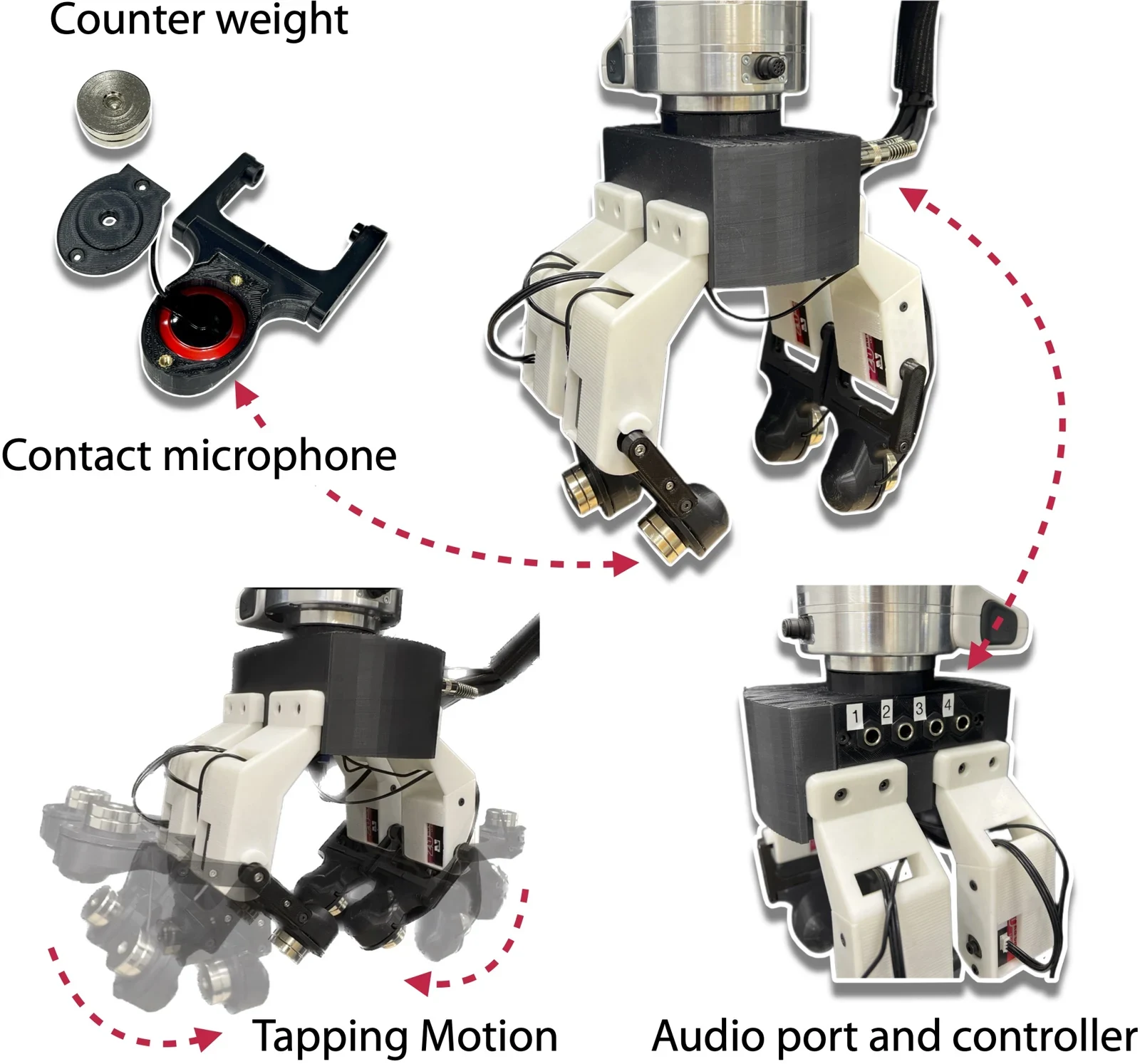
Duke describes a four-finger hand with a contact microphone in each fingertip. The hand taps, grasps and shakes objects while recording vibrations transmitted through contact. The system uses the resulting signals to infer properties of the object.
The research evaluates 83 real-world objects. Its reported tasks include material prediction, shape reconstruction, object re-identification and distinguishing container inventory states. The paper describes an exploration policy and learned models for processing the observations. These results cover the authors' object set and evaluation protocol.
The contact is part of the sensor
A vibration measurement depends on where the finger touches, how hard it presses and which other fingers support the object. A weak contact can attenuate the signal. A different support can change how the object vibrates. Those changes can occur while the camera image appears almost identical.
An evaluation should therefore record the interaction alongside the audio. The commanded motion, measured contact state and microphone sample window help another researcher understand the signal. A material label without that context can conceal variation caused by the hand itself.
What contact microphones contribute
A fingertip contact microphone measures vibrations transmitted through the object and finger. This gives it a different input from a microphone listening through the surrounding air. Duke's account explains the use of direct contact to reduce the influence of ambient sound.
Direct contact still leaves other sources of variation to investigate. The robot's motors and structure can transmit vibration, and the contact surface can change through wear. Treat rejection of room noise as one test condition, then measure how these other paths affect the recorded signal.
Hold out complete objects during testing
A system that recognizes another recording of a familiar object has passed a different test from one that classifies a new object. Splitting repeated taps from the same object between training and test sets can blur that distinction.
A useful evaluation would identify which complete objects are held out, along with material, geometry and container contents. It could then repeat the same object under different grasp positions and support conditions. These are proposed reporting steps for judging transfer, rather than additional SonicSense results.
For container inspection, publish the tested fill states and the allowed motions. A container with loose rigid pieces presents a different sensing problem from one holding a viscous liquid. A general phrase such as content recognition cannot convey those differences.
From sensing to a manipulation decision
An acoustic estimate becomes useful when it changes a later action. A robot might request another observation, choose a handling motion or flag an uncertain item for review. The sensing paper should be read separately from any claim that a robot can complete an entire sorting or household workflow.
For a deployed system, measure the number of interactions required, the time spent inspecting, object damage and the rate of incorrect decisions. Include an unknown-object outcome so that every unfamiliar signal does not have to receive a confident familiar label.
A humanoid hand also has packaging constraints. Finger movement, cable routing, mechanical protection and contact material can alter the signal path. A successful laboratory hand gives engineers a sensing approach to investigate. Evidence from the final hand and the intended object range is still needed to judge repeated use.
Sources and methodology
Research analysis based on the SonicSense paper and Duke's report. Proposed evaluation conditions describe further checks, not experiments performed by TechniaHQRobot.
Share this article
Share the current TechniaHQRobot article page.
Continue reading
Open the latest robotics reporting, Physical AI analysis and hardware notes.