
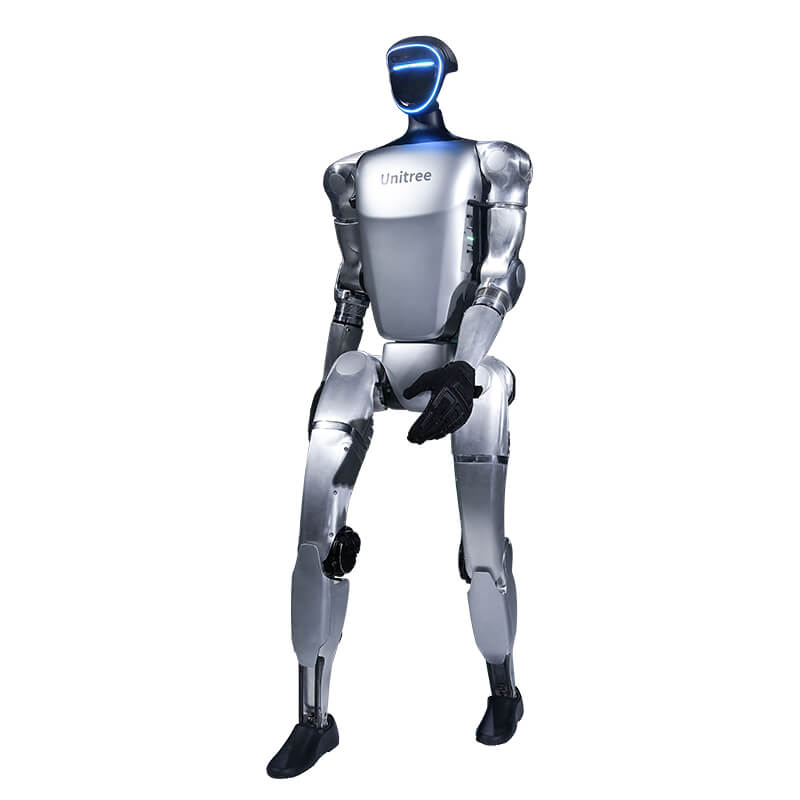
Introduction
The standard G1+ is listed at RMB 95,000 including tax in China. Unitree's current Chinese G1 page lists the earlier G1 from RMB 85,000, putting the listed difference at RMB 10,000 before configuration choices.
The published standard-model changes include 23 to 25 joint motors and an arm-load rating of about 2 kg to 3 kg. Unitree makes that load posture-dependent. Both pages still list a 9,000 mAh battery and about two hours of operation; the motor changes do not establish longer battery endurance.
Information verified from official sources available as of September 29, 2026.
Unitree G1+ hardware changes to test
| Subsystem | Published change | Useful acceptance check |
|---|---|---|
| Neck | +2 DOF; pitch about -25° to 36°; yaw ±110° | Target visibility without torso or foot repositioning |
| Shoulder and waist motors | +110% peak torque; -72% heat at matched torque | Temperature and torque during repeated loaded cycles |
| Arm motors | +43% peak torque; -30% heat at matched torque | Repeated reach and carry cycle under target payload |
| Vision | Stereo pair, chest wide-angle camera and 3D lidar | Task success by distance, lighting and occlusion |
| Audio | Six microphones and two 10 W speakers | Speech recognition by distance and noise level |
| Power | External power supported; input rating not specified on the current product page | Long-session operation and cable impact on workspace |
Published changes come from Unitree. Acceptance checks are TechniaHQRobot suggestions.
Two neck joints change where the robot can look
G1+ adds two neck degrees of freedom. Unitree lists pitch from about minus 25 degrees to 36 degrees and yaw of plus or minus 110 degrees. A movable head can point cameras toward a person or work area without rotating the entire torso.
That can reduce body motion during inspection and conversation, while camera placement still needs task testing. Looking toward an object does not establish depth accuracy, recognition quality or manipulation success.
Motor updates target torque and heat
Unitree says peak torque at the shoulder and waist rises 110 percent, while heat at the same torque falls 72 percent. Arm peak torque rises 43 percent with a 30 percent reduction in heat at the same torque. The company also reports a 28 percent heat reduction for thigh motors under matched torque.
These percentages are manufacturer measurements. A deployment test should record joint temperature during the actual motion cycle, including pauses, repeated reaches and recovery motions. Thermal behavior over a short sequence can differ from a multi-hour lab session.
The sensing and audio stack changes more than the silhouette
Unitree lists a stereo pair, one chest wide-angle camera and 3D lidar. The wide-angle camera is not a second camera in addition to the chest camera. The head has touch sensing, but the current specification does not state five separate touch points.
For audio, the robot uses six microphones arranged with four at the front and two at the rear. Unitree lists direction-of-arrival processing, noise reduction and echo cancellation, alongside two 10 W speakers. A rear external power connection can support long stationary sessions without relying only on the removable battery.
A buyer can test each upgrade with a matching workload
For the neck, measure how often the robot can keep the target in view without repositioning its feet. For motor heat, repeat the same loaded motion until temperatures stabilize. For audio, test recognition at several distances with background noise.
For external power, record whether the cable changes reachable workspace or creates a trip hazard in the intended setup. For stereo vision, compare depth or task success across lighting and object distances rather than relying on camera resolution alone.
Limitations and missing information
- Torque and thermal percentages are published by Unitree and were not independently measured by TechniaHQRobot.
- The listed China price is tax-inclusive for the standard G1+. EDU pricing is available through sales and configuration can change the final cost.
Sources and methodology
Share this article
Share the current TechniaHQRobot article page.
Continue reading
Open the latest robotics reporting, Physical AI analysis and hardware notes.