
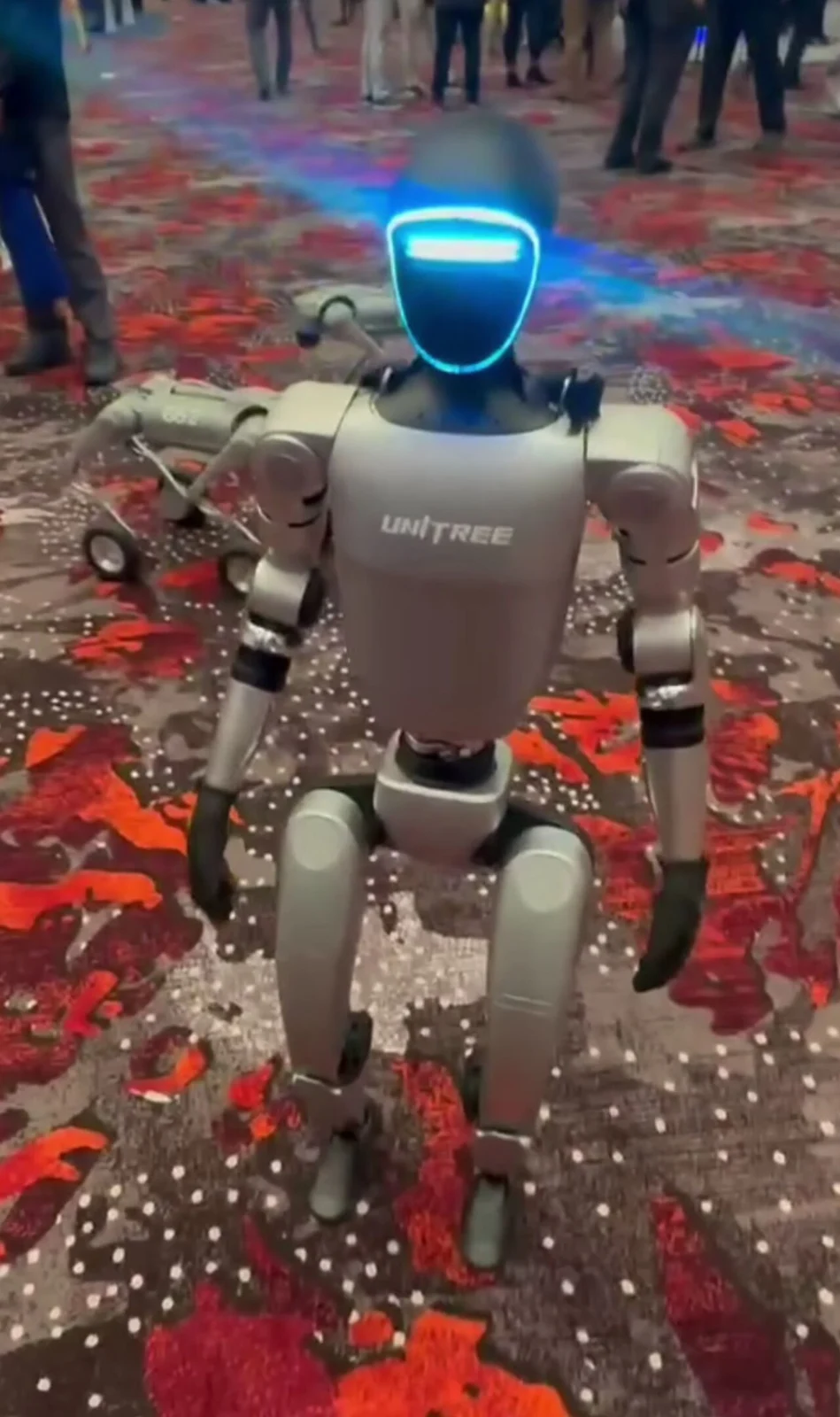

A rare public-market stress test for humanoid robotics extreme share demand now has to be matched by deployment economics.
Introduction
More than 8,000 buyers can want the same share without proving that the underlying robot business is already mature. Unitree's Shanghai offering is a useful case study because the market is pricing two things at once a fast-growing robotics manufacturer and an option on a much larger humanoid economy that has not yet been proven.
Reuters reported that Unitree priced the deal at RMB 150.80 per share and sought roughly RMB 6.1 billion, about $904 million. Retail demand exceeded the initial allocation by more than 8,000 times. The interesting question is not whether investors are excited. It is what operating evidence would have to arrive next to justify that excitement.
Research date August 12, 2026. Source review date recorded for this article August 12, 2026.
Key findings
- Retail demand exceeded the initial tranche by more than 8,000 times, while the final retail lot-winning rate was about 0.018% after reallocation.
- The offering seeks about RMB 6.1 billion, roughly $904 million, and values Unitree above RMB 60 billion.
- Reuters reported a valuation around 219 times 2025 earnings and 36 times sales, making future execution central to the investment case.
- Unitree says IPO proceeds will support embodied-AI models, robot-body research and manufacturing expansion.
- Current humanoid demand still includes substantial research, education and government-backed use, so strong investor demand is not the same as proof of mass labor replacement.
The numbers behind the 8,000× headline
Oversubscription measures demand for the offered shares, not demand for Unitree robots. When a small retail allocation meets a large pool of subscriptions, the ratio can become spectacular even if the company itself is not selling 8,000 times more products. Reuters reported that Unitree's retail tranche was subscribed more than 8,000 times before the final reallocation, leaving a lot-winning rate of roughly 0.018%.
The deal price was RMB 150.80 per share. Unitree aimed to raise about RMB 6.1 billion, or roughly $904 million, at a valuation above RMB 60 billion. That makes the IPO unusually important for robotics because it gives public investors a direct price on a company whose brand spans quadrupeds, bipedal humanoids, research hardware and embodied-AI development.
What investors are paying for today
Reuters reported that Unitree's 2025 revenue rose more than fourfold to nearly RMB 1.7 billion, with adjusted net profit around RMB 600 million. More than 40% of revenue came from overseas markets. Those figures show a real operating business rather than a pre-revenue robotics story.
The harder part is revenue quality. Robotics revenue can mix repeatable product sales with research purchases, demonstrations, one-off projects, accessories and institutional procurement. For humanoids in particular, buyers should separate robots shipped to laboratories or showcases from machines performing reliable, economically useful work for long shifts.
Why the valuation creates a demanding execution test
Reuters put the offer valuation at about 219 times 2025 earnings and 36 times sales. At those multiples, small changes in assumptions about growth, margins and market size can produce large changes in what the equity appears to be worth. The market is implicitly expecting Unitree to convert engineering visibility into much larger commercial demand.
That requires more than faster walking or impressive demos. It requires manufacturing yield, field reliability, spare parts, service infrastructure, safer control, dexterous manipulation, endurance and software that lets customers solve a task without building the entire autonomy stack themselves.
Where the IPO money is going
Unitree plans to direct proceeds toward embodied-AI model development, robot-body research and manufacturing expansion. Those three buckets are tightly linked. Better policies need more robot data; more data requires more hardware operating in the field; more hardware requires production capacity and quality control.
This is also why humanoid companies consume capital quickly. A model company can distribute software cheaply once trained. A robotics company must finance motors, reducers, batteries, sensors, hands, test rigs, service inventory and physical data collection while still paying for large AI teams and compute.
What would validate the bull case after listing
The cleanest evidence would be repeat orders from customers using robots in production, rising utilization hours, lower intervention rates and stable gross margins as shipments grow. Public investors should also watch customer concentration, warranty expense, service burden, overseas exposure and how much revenue comes from humanoids versus established quadruped products.
One metric is especially valuable useful autonomous hours per robot between human interventions. It connects software, hardware and deployment economics. A robot that ships in volume but needs frequent teleoperation or maintenance can generate impressive unit counts without delivering the labor economics investors expect.
What the 8,000× figure does not prove
It does not prove that humanoids are ready to replace workers, that Unitree will dominate the category or that the shares are cheap. Reuters noted that current humanoid demand still comes heavily from universities and government-backed projects, while the technology continues to face reliability, dexterity, endurance and generalization limits.
The IPO is therefore a market signal, not a technology benchmark. It shows that investors are willing to fund a long robotics build-out at a high valuation. The next evidence has to come from deployments, repeat purchases and operating performance after the excitement of allocation disappears.
Limitations and missing information
- IPO demand ratios depend on allocation mechanics and should not be interpreted as product-market demand.
- The valuation and financial figures reflect the offering information reported in August 2026 and can move after trading begins.
- Unitree sells multiple robot categories, so company-level revenue is not equivalent to humanoid-only revenue.
- Future humanoid adoption depends on reliability, safety, cost and task performance that are not established by an IPO.
Conclusion
Unitree's IPO matters because public markets are now assigning a concrete valuation to one of the world's most visible robotics manufacturers. The 8,000× oversubscription shows exceptional investor competition for the allocation, but the operating test begins after listing.
The useful scoreboard is no longer demo virality. Watch repeat customer orders, autonomous utilization, intervention rates, gross margins, service costs and the share of revenue tied to productive deployments. Those numbers will reveal whether investors bought a robotics manufacturer with durable economics or paid early for a humanoid market that still needs to be built.
Frequently asked questions
Was Unitree IPO really oversubscribed 8,000 times?
Reuters reported that the retail tranche was subscribed more than 8,000 times relative to the initial retail allocation. That ratio describes share demand, not robot demand.
How much is Unitree raising?
The Shanghai offering seeks about RMB 6.1 billion, roughly $904 million at the exchange rate used by Reuters.
What is Unitree valued at?
Reuters reported a post-offering valuation above RMB 60 billion, with the offer priced around 219 times 2025 earnings and 36 times sales.
What should investors watch after the IPO?
Repeat production orders, humanoid revenue mix, autonomous operating hours, human intervention rates, warranty and service costs, gross margin and overseas revenue exposure are more informative than demo views.
Sources and methodology
This archive interprets the August offering figures reported by Reuters. Share allocation and valuation figures are separated from evidence about robot demand, revenue mix and operating reliability.
Related TechniaHQRobot guides
Source review notes
No review date recorded
Share this article
Share the current TechniaHQRobot article page.
Continue reading
Open the latest robotics reporting, Physical AI analysis and hardware notes.