
Introduction
On September 7, Unitree published a video that it described as a fully autonomous humanoid fighting demonstration driven in real time by a world model. Chinese outlets identify the model as UnifoLM-X2-1.0 and repeat Unitree's statement that the system performs prediction, planning, decision making and dynamic interaction without remote control or a preset fighting script.
The sequence is useful as a stress case because contact changes the robot's state every moment. It remains a company demonstration rather than a public benchmark. Unitree has not published the trial count, failure rate, control-latency distribution or a technical paper that would let outside teams reproduce the result.
Information verified from official sources available as of September 24, 2026.
Claims in the fighting announcement and missing evidence
| Question | Public evidence | Still needed |
|---|---|---|
| Was autonomous control verified? | CLAIMED by Unitree in the cited reports; not independently verified here | Original recording, control disclosure and repeated trials |
| What model was named? | UnifoLM-X2-1.0 | Architecture, parameter count and training-data description |
| Can it handle dynamic contact? | Company demonstration described by the cited reports | Direct footage review and repeated-trial recovery rates |
| How fast is the control loop? | No latency distribution published | Sensor-to-command timing and compute configuration |
| Does it generalize to other jobs? | No task benchmark was published with the fighting announcement | Separate manipulation, navigation and safety evaluations |
The Paper reproduces a Unitree claim. This audit could not verify the original video or establish independent autonomy.
Fighting compresses several control problems into seconds
A striking motion from an opponent changes the visual scene and can also push the robot physically. The controller has to estimate body state, select a response and keep balance while contacts arrive at uncertain times.
A useful system has little time to separate perception, prediction and control. Delays can make a correct decision arrive after the robot has already moved or been hit. That makes end-to-end latency and recovery time useful measures for this type of test.
The video can show that a sequence occurred. It cannot by itself reveal how often the same policy fails across repeated bouts, whether opponent behavior was varied, or how many resets were needed before recording the published run.
Unitree describes X2 as a world-action model
Unitree's statement, as reported by Chinese outlets, says UnifoLM-X2-1.0 performs real-time prediction and planning for high-dynamic interaction. The company frames the system as a world-action large model.
Unitree's G1 product page has long described UnifoLM as its unified robot model family. The X2-1.0 announcement adds a demanding interaction example, but public sources do not disclose enough architecture detail to compare parameter count, training data, observation rate or action horizon with other robot models.
For technical comparison, those missing fields matter. Without the timing and hardware setup, the video should not be turned into a numerical performance ranking.
A reproducible test would report failures as carefully as successes
A benchmark could define the same starting distance, allowed actions and bout duration, then repeat trials against several opponent policies. Report falls, successful recoveries, emergency stops and outside interventions for every run.
Latency should be measured from sensor capture to command output, with median and high-percentile values. Average latency can hide occasional slow frames that cause a fall during fast contact.
A second test could remove the opponent and apply controlled pushes. That would separate balance recovery from strategy selection. Another could use scripted opponent motions so two models face the same sequence.
The available evidence supports a narrow conclusion
The reports attribute fully autonomous fighting to Unitree's announcement. This review did not independently inspect the original recording or verify its control mode. The reports do not establish performance in warehouses, homes or factories.
Those environments require different perception, grasping, safety and task-completion tests. A world model that reacts well to an opponent may still need separate data and policies for handling objects or working near people.
A technical report with repeated trials, model timing, hardware configuration and failure cases would let researchers judge how much of the observed behavior comes from the model, the low-level controller and the robot's mechanical recovery capability.
Limitations and missing information
- No peer-reviewed paper or standardized benchmark accompanied the September 7 fighting announcement in the sources reviewed.
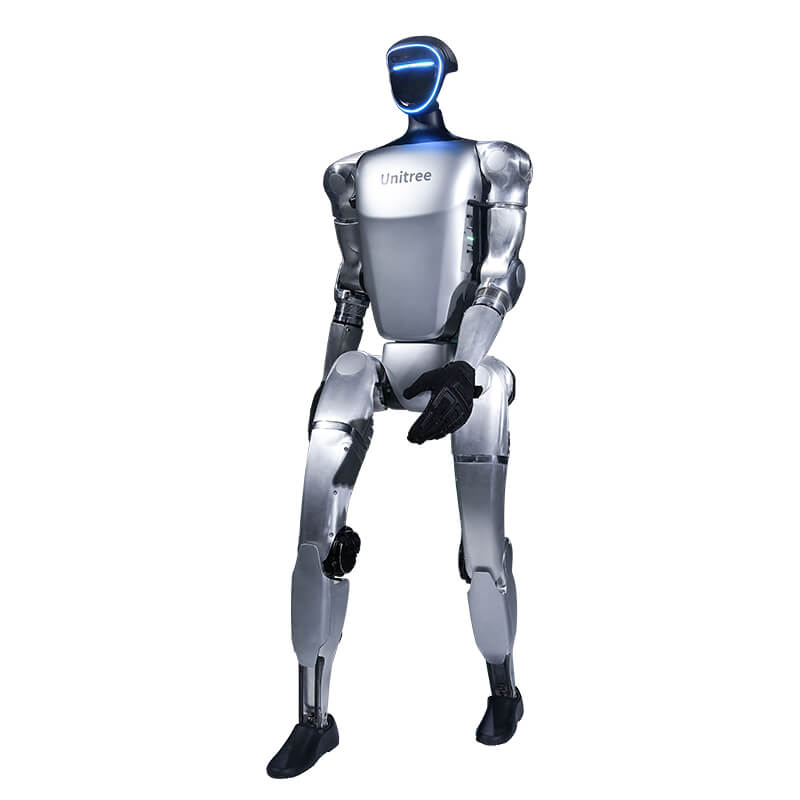
- The local image is a Unitree G1 reference image; public reports reviewed for this article do not identify every hardware configuration used in the fighting video.
Sources and methodology
Share this article
Share the current TechniaHQRobot article page.
Continue reading
Open the latest robotics reporting, Physical AI analysis and hardware notes.