
Introduction
A rigid mug has a compact state position, orientation and perhaps whether the gripper holds it. A towel can occupy thousands of shapes while still being the same towel. One corner disappears under a fold, friction changes across materials and every grasp changes the geometry the camera must interpret next.
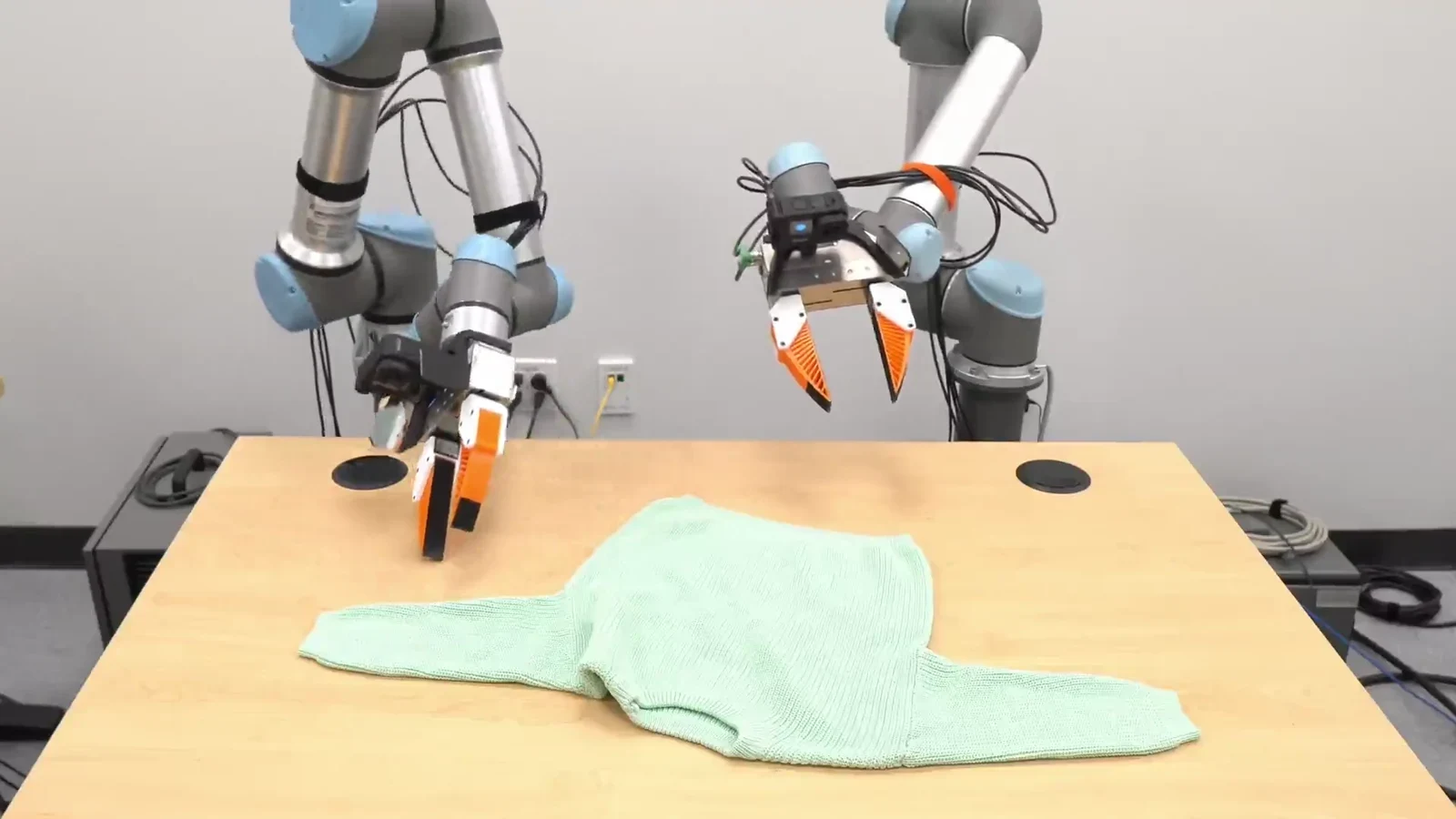
That is why laundry is more than a cute household demo. It compresses several unsolved manipulation problems into one task deformable-state estimation, self-occlusion, bimanual coordination, regrasping, contact planning and a goal that is defined by shape rather than a single object pose.
Research date August 12, 2026. Source review date recorded for this article August 12, 2026.
Key findings
- Deformable objects have far more possible configurations than rigid objects, making state estimation and planning difficult.
- Fabric self-occludes, so the robot often needs memory or active perception to track corners and layers that leave the camera view.
- Folding usually requires coordinated two-hand actions, tension control and repeated regrasping rather than one stable grasp.
- SoftMimicGen generates training data across towels, rope, tissue and other deformables on multiple embodiments, including humanoids.
- Laundry success should be measured by fold quality, recovery, cycle time and generalization across material and size, not a single prepared demonstration.
The state space explodes when the object bends
For rigid manipulation, a six-degree-of-freedom pose is often enough to describe the object for planning. A shirt or towel needs a distributed shape representation. Two visually similar folds can hide different layer order, tension and contact state.
That makes both perception and prediction harder. The robot must decide which geometric features matter for the next action without reconstructing every fiber.
Self-occlusion breaks reactive vision
When a robot folds one side of a towel, a target corner can disappear underneath fabric or behind the gripper. A policy that only sees the current frame may no longer know which layer it is holding.
Active perception and memory help lift the fabric, change viewpoint, remember the tracked corner and verify that the expected layer moved. This turns folding into a partially observable task rather than simple image-to-action mapping.
Two hands are useful because fabric needs tension
Humans often stabilize one region while moving another. That creates controlled tension and prevents the entire garment from sliding. A single gripper can complete some folds with clever fixtures, but general clothing manipulation benefits from bimanual coordination.
Two arms also double the collision and coordination problem. The robot must reason about both wrists, the deformable object between them and how each contact changes the other hand's reachable set.
Friction and material make visual generalization unreliable
A thick towel, silk shirt and stretchy T-shirt can look equally easy in RGB but respond differently to the same pull. Friction against the table, fabric stiffness and compliance change the resulting shape.
Force and tactile sensing can provide evidence that vision cannot whether the gripper captured one layer or several, whether tension is rising and whether cloth is slipping. This is one reason tactile research is increasingly relevant to home robotics.
SoftMimicGen attacks the data bottleneck
Collecting thousands of real fabric demonstrations is slow because every failed rollout leaves the object in a new configuration that a human may need to reset. SoftMimicGen proposes a scalable data-generation system for deformable-object manipulation across stuffed animals, rope, tissue and towels.
The paper spans single-arm, bimanual, humanoid and surgical embodiments and includes folding, threading, whipping and pick-and-place behaviors. The value is not that synthetic data solves fabric manipulation, but that it can multiply difficult demonstrations into varied training states.
What a credible laundry benchmark should report
A strong benchmark varies garment size, material, initial crumple, table friction and lighting. It reports how often the robot identifies the correct layer, how many regrasps it needs, final alignment error, task time and whether it recovers after a corner is lost.
A single successful fold on a carefully laid towel proves a skill exists. Repeated folds on previously unseen garments with low intervention show whether the skill is becoming useful.
Limitations and missing information
- Laundry is a representative deformable-object stress test, not one universally standardized benchmark across the field.
- Simulation and synthetic data can model geometry more easily than real friction, compliance and tactile contact.
- Prepared garments and fixed starting poses can make demos substantially easier than real household laundry.
- Cycle time and reset labor are often omitted from research success rates.
Frequently asked questions
Why is folding clothes hard for robots?
Fabric is deformable, self-occluding and sensitive to friction. The robot must track shape and layers, coordinate two hands, regrasp and control tension.
Why is laundry harder than pick-and-place?
Rigid pick-and-place can often use one object pose and one grasp. Laundry changes shape after every action and the final goal is a geometric configuration, not a single pose.
Can tactile sensors help?
Yes. Touch and force can detect slipping, layer count and tension that RGB cameras may not reveal.
What does SoftMimicGen contribute?
It generates scalable robot-learning data for deformable-object tasks across several object types and robot embodiments, reducing dependence on manual real-world resets.
Sources and methodology
The article relies chiefly on the SoftMimicGen research paper. Its simulation tasks do not establish household laundry reliability. This September 29 cleanup removes a repeated deployment checklist and an unrelated financing-source statement; a task-specific experimental comparison remains an editorial requirement.
Related TechniaHQRobot guides
Source review notes
No review date recorded
Share this article
Share the current TechniaHQRobot article page.
Continue reading
Open the latest robotics reporting, Physical AI analysis and hardware notes.