

Introduction
Space robotics market reports agree on growth and disagree on the number. Current commercial estimates place the 2026 market around the high-$5-billion to low-$6-billion range, but their forecast totals and category definitions diverge. That makes a single CAGR a weak foundation for understanding where money is actually being spent.
A better market map starts with missions servicing satellites in orbit, robotic manipulation on stations, lunar mobility, planetary sample handling, inspection and in-space assembly. NASA and ESA programs in 2026 show concrete engineering demand for dexterous arms, autonomous rendezvous, tool use and reliable mobility.
Key findings
- Published 2026 market estimates differ Fortune Business Insights projects $5.95B for 2026, while Precedence Research cites $6.21B and Global Market Insights $5.9B; definitions and forecast horizons are not identical.
- NASA’s Fly Foundational Robots mission is planned for late 2027 and aims to operate a commercial dexterous robotic arm in low Earth orbit with autonomous tool use and mobility across spacecraft structures.
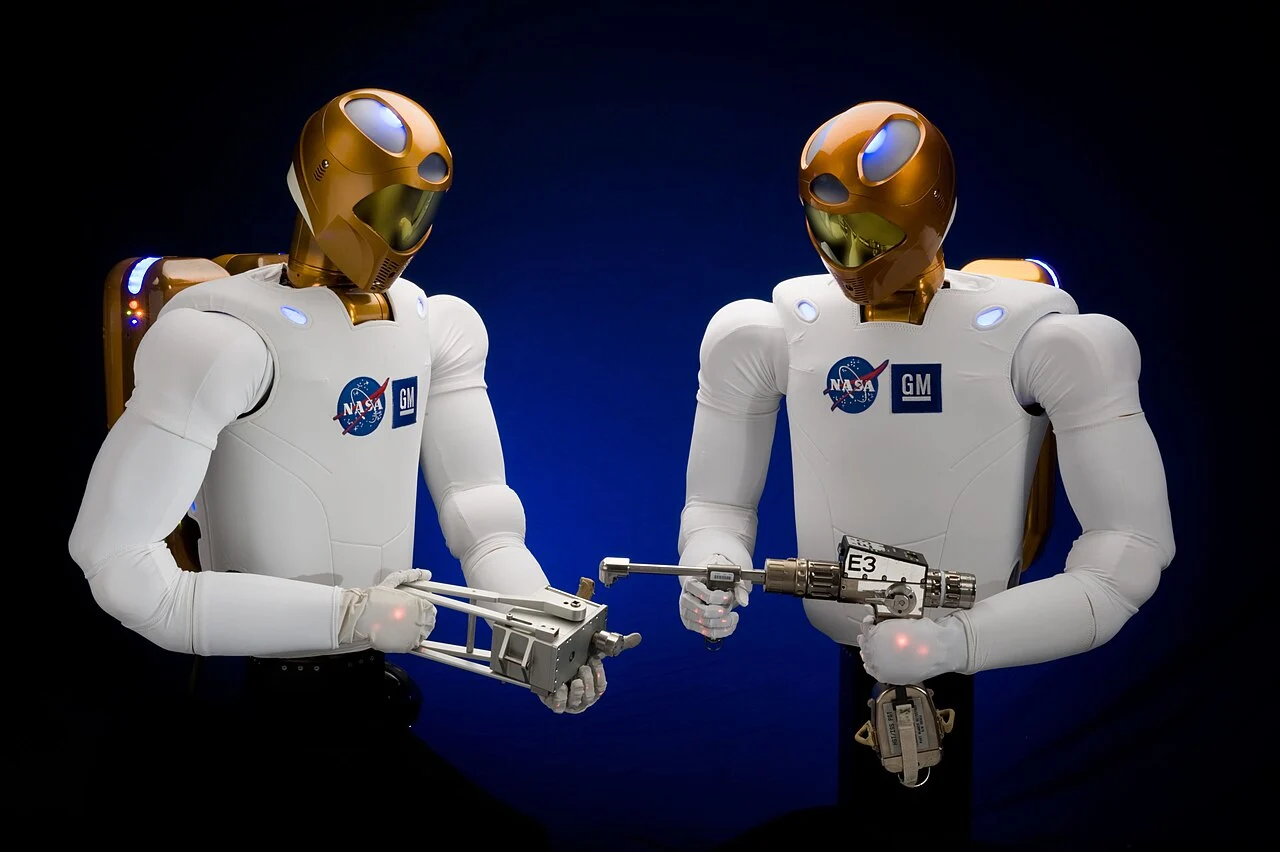
- NASA reported in July 2026 on a robotic servicing mission using twin dexterous arms for multi-mission in-space servicing.
- ESA’s Sample Transfer Arm is a 2.4-meter, seven-degree-of-freedom system with two cameras and additional sensors for future Mars sample-handling work.
- The economically useful market segments are easier to verify through funded missions and hardware programs than through one global market-size number.
Published 2026 space robotics market estimates
These are third-party market estimates with different definitions and methods; they should not be averaged into a false precision.
| Source | 2026 estimate | Forecast cited |
|---|---|---|
| Fortune Business Insights | $5.95B | $13.75B by 2034 |
| Precedence Research | $6.21B | $12.09B by 2034 |
| Global Market Insights | $5.9B | $12.4B by 2035 |
Space robotics demand by mission
| Segment | Robot capability | Commercial/mission value |
|---|---|---|
| On-orbit servicing | Rendezvous, grapple, inspect, manipulate | Extend or restore asset utility |
| ISAM | Tool use, assembly, mobile manipulation | Build/service infrastructure after launch |
| Planetary mobility | Navigate terrain, transport payloads | Explore and move hardware/samples |
| Sample handling | Precision vision, grasping, force control | Handle scientifically valuable material |
Why market reports disagree
One report may count launch-related automation, ground robotics and planetary rovers; another may focus on in-space robotic systems. Some include software and services, others emphasize hardware. Currency assumptions, base years and proprietary data sources also differ.
For 2026, Fortune Business Insights cites $5.95 billion, Precedence Research $6.21 billion and Global Market Insights $5.9 billion. These values are close enough to show the same order of magnitude, but their later forecasts diverge more. Treat them as third-party estimates, not audited industry revenue.
On-orbit servicing is becoming an operational market
Satellite life extension, relocation, inspection and repair create demand for rendezvous sensors, robotic arms, end effectors and autonomous operations. In July 2026 NASA described a U.S. robotic servicing mission using twin dexterous arms integrated onto a multi-mission robotic vehicle.
The value proposition is straightforward a spacecraft that can inspect, reposition or service another asset can potentially extend useful life or reduce the need to replace hardware. The technical difficulty is not straightforward because the target may be uncooperative, communications delayed and contact dynamics unforgiving.
ISAM robots that assemble and manipulate in orbit
NASA’s In-Space Servicing, Assembly and Manufacturing program is developing capabilities that go beyond docking. Its Fly Foundational Robots mission, planned for late 2027, will demonstrate a commercial arm that can perform dexterous manipulation, autonomous tool use and “walk” across spacecraft structures in microgravity or partial gravity.
That pushes space robotics toward mobile manipulation rather than fixed station arms. It also creates demand for force control, tool interfaces, vision, planning and fault recovery designed for environments where a technician cannot walk over and reset the machine.
Planetary robotics mobility is only the first layer
Rovers are the most recognizable space robots, but future systems increasingly combine navigation with manipulation and construction-like tasks. Lunar programs need mobility across dust, slopes and lighting extremes, plus payload delivery, drilling, sample handling or infrastructure support.
The commercial opportunity is fragmented across complete rovers, wheels, actuators, navigation software, power, communications and mission operations. A “rover market” headline can hide this supplier stack.
ESA’s Sample Transfer Arm shows the precision end of the market
ESA says the Sample Transfer Arm can extend to 2.4 meters, uses seven degrees of freedom and is assisted by two cameras and an array of sensors. The job is not generic manipulation identify, collect and transfer precious sample tubes with reliability high enough for an interplanetary mission.
This is a useful counterpoint to humanoid robotics. Space robots are often highly task-specific because reliability, mass and mission assurance dominate flexibility. Commercial value can therefore come from narrow capability with extreme verification rather than general-purpose behavior.
The market map five revenue pools to watch
- On-orbit servicing rendezvous, inspection, grappling, relocation and repair.
- Robotic arms and manipulators station operations, payload handling, tool use and assembly.
- Lunar and planetary mobility rovers, payload transport, sampling and site preparation.
- Autonomy software navigation, perception, fault management and delayed-communications operation.
- Integration and mission operations qualification, testing, ground systems and lifecycle support.
What would prove the market is moving from programs to scale?
Watch repeat missions, standardized interfaces, commercial servicing contracts, recurring rover payload delivery, on-orbit refueling/repair transactions and hardware reused across customers. Those signals matter more than a one-off technology demonstration.
Also watch failure and maintenance evidence. Canadarm2 required a wrist-joint repair in June 2026 after more than 25 years of operation, a reminder that long-lived space robotics is an asset-management problem as much as a launch problem.
Limitations and missing information
- Product specifications, software capabilities, prices and availability can change; verify the exact configuration before procurement.
- A successful vendor demonstration does not establish production uptime, intervention rate or performance in a different facility.
- Safety guidance here is educational and does not replace a site-specific risk assessment, integrator validation or applicable regulations.
Conclusion
The 2026 space robotics market is real, but it is better understood as a set of mission-driven markets than one precise global number. Follow funded servicing, manipulation, mobility and assembly programs to see where capability is becoming repeatable economic activity.
Frequently asked questions
How big is the space robotics market in 2026?
Third-party estimates are around $5.9B–$6.2B for 2026 in several current reports, but the figures are not directly comparable because market definitions and methodologies differ.
What are the main space robotics market segments?
Major segments include on-orbit servicing, robotic arms/manipulation, lunar and planetary rovers, inspection, in-space assembly/manufacturing, autonomy software and mission integration.
What is ISAM?
ISAM stands for In-Space Servicing, Assembly, and Manufacturing. NASA uses the term for capabilities that inspect, service, assemble or manufacture spacecraft infrastructure after launch.
Are space robots autonomous?
Autonomy varies by mission. Many systems combine pre-programmed sequences, ground-supervised operations and autonomous functions because communication delays and contact risk make unrestricted autonomy difficult.
Why are space robotic arms important?
They can move payloads, capture or service spacecraft, use tools and perform assembly tasks where human EVA is expensive or impossible.
Sources and methodology
Related TechniaHQRobot guides
Share this article
Share the current TechniaHQRobot article page.
Continue reading
Open the latest robotics reporting, Physical AI analysis and hardware notes.