
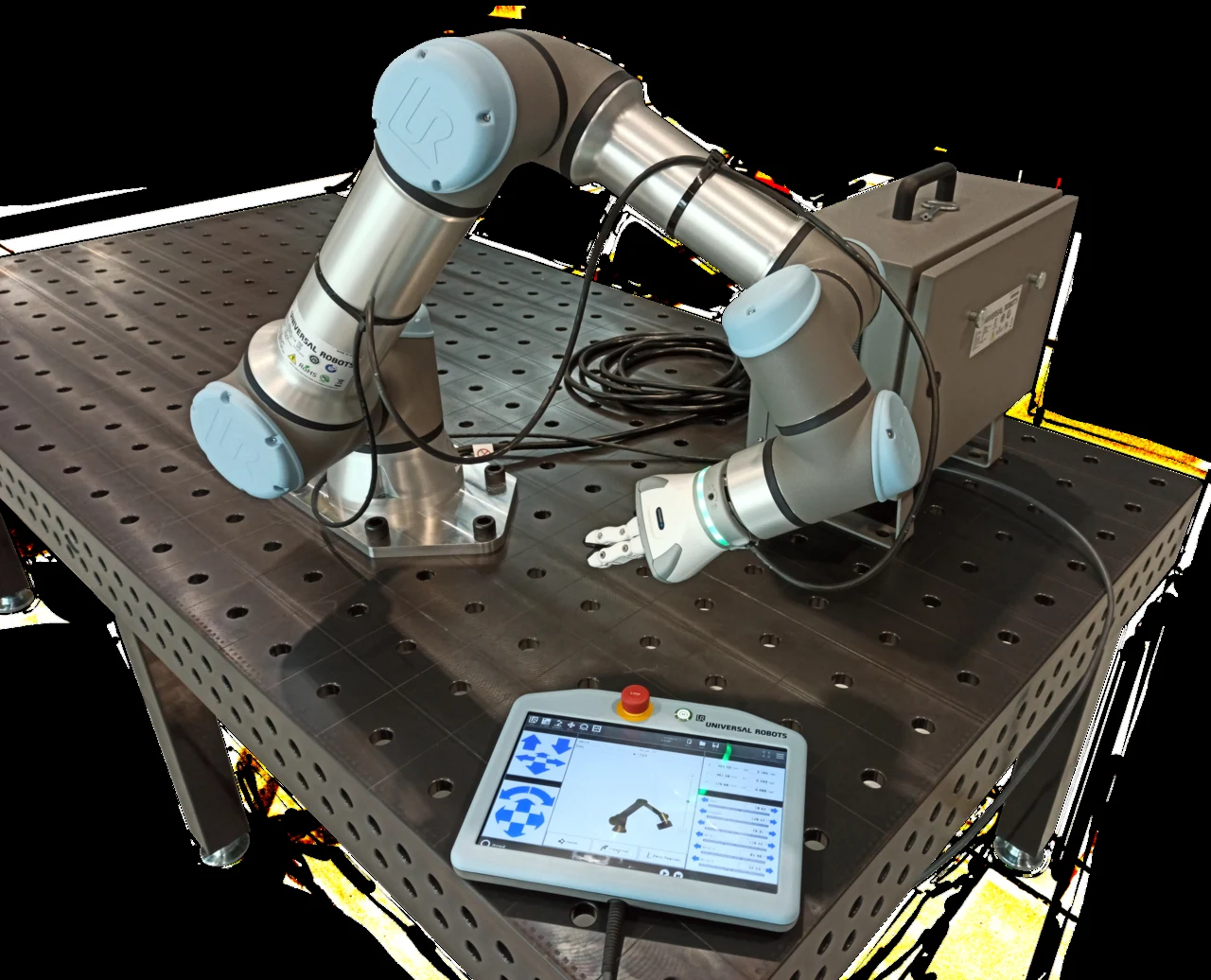

Introduction
A robotic arm is rarely the largest unknown in a robot project. The complete budget includes the controller, end effector, fixtures, safety hardware, machine interfaces, electrical panels, programming, validation and production support. A $35,000 arm can become part of a $120,000 cell when the process needs vision, guarded access and custom tooling. A heavy welding or palletizing installation can move far beyond the visible robot price.
This guide separates public list prices from planning allowances. Most industrial manufacturers sell through quotations and regional integrators, so exact 2026 prices depend on payload, reach, controller, options, country and support. The five budgets below are illustrative engineering scenarios, not vendor offers. Each assumption is shown so a buyer can replace it with local quotes. Taxes, freight, customs, facility work and production downtime are excluded unless stated.
Key findings
- In the five illustrative budgets below, the robot and controller allowance represents about 27% to 50% of the total. These examples are not a market survey.
- Grippers, fixtures and process tooling often decide whether the robot can hold tolerance across real parts.
- A collaborative robot does not remove the need for a risk assessment; speed, payload, sharp tools and pinch points can still require guarding.
- Integration hours rise when the robot must communicate with legacy PLCs, CNC machines, conveyors, vision systems or quality databases.
- Maintenance, spare parts, software licenses and retraining should be budgeted before calculating payback.
Illustrative 2026 robotic cell budgets
These are transparent planning examples created for this article. They are not quotes from ABB, FANUC, KUKA, Yaskawa, Universal Robots or an integrator.
| Scenario | Robot and controller allowance | Tooling and peripherals | Engineering and safety | Illustrative total |
|---|---|---|---|---|
| Small laboratory cobot | US$35,000 | US$12,000 | US$23,000 | US$70,000 |
| CNC machine tending cell | US$45,000 | US$35,000 | US$55,000 | US$135,000 |
| Arc-welding cell | US$55,000 | US$60,000 | US$85,000 | US$200,000 |
| Palletizing cell | US$65,000 | US$55,000 | US$80,000 | US$200,000 |
| High-payload handling cell | US$120,000 | US$125,000 | US$205,000 | US$450,000 |
Replace every allowance with written supplier quotations before approving capital expenditure.
Start with the application, not the catalog price
The first cost decision is the process. A robot that transfers identical boxes between two fixed points needs a different cell from one that locates mixed castings, deburrs an edge and records inspection data. Payload must include the part, gripper, adapters, cables and any wrist-mounted camera. Reach must cover the work envelope without forcing the wrist near singularities or joint limits. Cycle time must include approach, grasp confirmation, machine handshake and safe recovery after a failed pick.
A low purchase price can create a more expensive project if the arm lacks reach, stiffness, environmental protection or controller interfaces. Conversely, buying excess payload can increase floor space, guarding distance and energy use. A useful request for quotation supplies drawings, part variation, target takt time, shift pattern, expected availability, utilities and acceptance criteria. That document lets integrators price the same problem instead of quoting incomparable concepts.
What the robot package normally includes
An industrial robot quotation usually identifies the manipulator, controller, teach pendant, cables and a software option set. It may not include a base, dress pack, fieldbus card, safety option, offline programming license or extended warranty. Cobot packages can appear more complete because the controller and pendant are marketed together, yet a production-ready installation still needs mounting, tooling, power, network configuration and process validation.
Ask whether the quoted controller supports the plant standard for EtherNet/IP, PROFINET, PROFIsafe, DeviceNet or another protocol. Confirm the number of digital and analog I/O points, safe inputs, external axes and vision interfaces. A missing software key can delay commissioning even when the physical arm is already bolted to the floor. Record controller generation because spare parts and compatible software versions can differ within the same robot family.
Grippers, tool changers and part presentation
The end effector converts robot motion into useful work. A two-finger pneumatic gripper may cost little compared with the arm, but custom fingers, valves, sensors, compliance and guarding around the jaws add engineering. Vacuum tooling needs cups, generators, filters and a strategy for porous or warped parts. Electric grippers add position and force control but may require software integration and protection from coolant, dust or weld spatter.
Part presentation often costs more than the gripper. Random parts in a bin may need 3D vision, a controlled background and a reject path. Flexible production can require an automatic tool changer and tool storage. Every connector adds failure modes air leaks, damaged cables, contaminated optics and incorrect tool identification. Budget spare fingers and wear components from the start, because a custom machined jaw can stop the cell as effectively as a failed servo.
Vision, sensors and measurement
A fixed 2D camera is appropriate when parts lie on a known plane and contrast is controlled. A 3D camera becomes useful for height variation, bin picking or pose estimation, but it adds calibration, lighting and compute requirements. The camera price is only one line. The cell needs a rigid mount, lens, enclosure, lighting, trigger wiring, calibration target and software that handles bad images rather than accepting the first detection.
Force-torque sensors, laser profilers, seam trackers and presence sensors can reduce uncertainty, yet each must be tied to an acceptance test. A force sensor is valuable for insertion or surface finishing only when the controller and process software can react at the required bandwidth. Instrumentation should be selected from the failure mode missing part, wrong orientation, excessive insertion force, weld seam deviation or dimensional drift.
Safety hardware and validation
Traditional cells use perimeter fencing, interlocked gates, emergency stops and safe controller functions. Collaborative applications may add safety scanners, pressure-sensitive devices or power-and-force limiting. The word “cobot” describes capabilities of the robot, not an automatically safe application. A sharp tool, hot workpiece or heavy payload can create hazards even at reduced arm speed. The final safety concept follows the complete task and the local regulatory framework.
Budget for risk assessment, safety circuit design, performance-level calculations, validation measurements and documentation. A scanner can require several protective fields for automatic, loading and maintenance modes. Stopping distance depends on speed, payload, braking and controller response. If the protective zone does not fit the available floor area, the mechanical layout may need to change after engineering has started. Early safety work is cheaper than moving fences during commissioning.
Mechanical, electrical and controls integration
Mechanical integration covers the robot base, fixtures, guarding, platforms, cable routing and interfaces with machines or conveyors. A concrete floor may need anchors or reinforcement. A mobile base needs repeatable docking and stability checks. Electrical work includes panels, disconnects, safety relays or safety PLCs, power supplies, network switches, valves and field wiring. Facility utilities such as compressed air, extraction or chilled water may sit outside the integrator’s quote.
Controls engineering links the robot to the rest of the process. Machine tending requires door control, chuck confirmation, program selection and recovery from machine alarms. A palletizer needs product tracking and pallet pattern management. Welding adds power-source communication, seam programs and fume extraction interlocks. The most expensive software is often not the normal cycle; it is the recovery logic that lets an operator restart safely after a dropped part or interrupted sequence.
Programming, simulation and acceptance
Offline simulation can validate reach, collisions and approximate cycle time before hardware arrives. It does not remove commissioning because real fixtures, cable behavior, gripper timing and machine responses differ from the model. A quoted programming effort should include normal production, manual modes, recipe management, alarms, maintenance screens and backups. Ask who owns source files, passwords and offline models after acceptance.
Factory acceptance testing should use representative parts and define measurable pass criteria. Site acceptance then verifies the installed cell with real utilities, operators and upstream equipment. A cycle time achieved for ten hand-selected parts is not the same as sustained output across a shift. Include a run-off period, scrap limit, changeover target and availability calculation. Without those terms, the buyer and integrator may disagree about whether the system is complete.
Five scenario budgets explained
The laboratory cobot example assumes a small arm, simple electric gripper, bench, guarding appropriate to the risk assessment and limited programming. The CNC scenario adds machine I/O, door automation, part trays, coolant-resistant tooling and more recovery logic. The welding cell adds a welding package, torch service equipment, extraction, positioner or fixtures and stricter guarding. Palletizing adds a larger work envelope, pallet detection and load-building software.
The high-payload cell assumes a large six-axis robot, engineered gripper, substantial steelwork, protected zones and complex commissioning. These totals are not market averages. They demonstrate how cost moves when tooling and engineering grow. A buyer can reproduce the calculation with three columns vendor hardware quotes, internally approved labor rates and a contingency tied to unresolved technical risks. The result is auditable and avoids hiding uncertainty inside one rounded “robot price.”
Operating cost, maintenance and spare parts
Annual cost includes preventive maintenance, grease and filters, batteries for backup systems, gripper wear parts, calibration, software support and technician time. Heavy-duty applications can consume dress packs, torch components or vacuum cups quickly. A plant with one unique robot model may need more local spares because a distributor lead time can stop production. A fleet using one controller generation can share training and inventory.
Energy is usually not the dominant ownership cost, but compressed air can be expensive and leaks are common. Downtime matters more. Estimate the contribution margin lost per stopped hour, then compare it with spare-motor, controller and service-contract costs. Remote support can shorten diagnosis but needs secure access and plant approval. Keep backups of robot programs, safety configuration, vision recipes and calibration data outside the controller.
How to compare integrator quotations
Normalize every quote into the same work breakdown robot, tooling, safety, mechanical, electrical, controls, software, commissioning, training, documentation, freight, warranty and exclusions. One integrator may appear cheaper because the customer is expected to provide fixtures, PLC code or guarding. Another may include a full production run-off and spare package. The lowest total on the cover page is meaningless until exclusions are aligned.
Ask for assumptions about part quality, operator tasks, changeover, upstream availability and acceptance. Request a list of third-party licenses and renewal fees. Confirm who performs CE marking or other conformity work where required. Finally, examine service response in the plant’s region. A technically excellent cell can still be a poor investment if a failed controller waits weeks for a specialist or if the source code cannot be maintained by the owner.
Limitations and missing information
- Illustrative budgets are planning scenarios, not official manufacturer or integrator prices.
- Public robot prices often exclude freight, tax, controller options, safety software, tooling, training and regional support.
- Facility modifications, production downtime during installation and financing costs are project-specific and excluded from the examples.
- Cycle time and availability cannot be guaranteed from simulation alone; representative production run-off is required.
- A collaborative robot may still require guarding or restricted operation after a task-level risk assessment.
Conclusion
The useful robotic arm cost is the accepted cost of a working process, not the catalog price of a manipulator. Build the budget from a defined task, then price the robot package, tooling, safety, integration, validation and ownership separately. The five scenarios total 2 to 3.75 times their robot and controller allowance. Written assumptions and measurable acceptance tests are the best protection against both underbudgeting and oversized equipment.
Frequently asked questions
How much does a robotic arm cost in 2026?
Public prices range widely, but many industrial models are quote-only. The complete project can be far higher than the arm because tooling, safety, fixtures, controls and integration are required.
Why can a cobot cell cost more than the cobot?
The arm is only one component. Grippers, machine interfaces, vision, safety analysis, fixtures, programming, validation and production support can exceed the hardware allowance.
Does a cobot eliminate fencing?
No. The application must be risk-assessed. Payload, speed, pinch points, sharp tools, hot parts or process hazards can require guarding or safety scanners.
What should an integrator quotation include?
It should identify hardware, software options, tooling, safety, mechanical and electrical work, programming, commissioning, training, documentation, warranties, acceptance tests and exclusions.
How much contingency should a robot project carry?
There is no universal percentage. Tie contingency to unresolved risks such as variable parts, legacy machine interfaces, uncertain cycle time, facility work and untested vision instead of applying an unexplained blanket number.
Sources and methodology
Evidence for robotic arm cost was rechecked on July 23, 2026 against Association for Advancing Automation, ISO, Universal Robots. Time-sensitive prices, permits, service areas and certifications stay dated, and a missing supplier value is not converted into an official specification.
Related TechniaHQRobot guides
Share this article
Share the current TechniaHQRobot article page.
Continue reading
Open the latest robotics reporting, Physical AI analysis and hardware notes.