

Introduction
The best beginner robotics kit exposes enough of the system to teach real engineering without burying the student in mechanical problems on day one. A useful kit has a documented controller, replaceable parts, accessible sensors, a safe power system and examples that can be modified rather than only replayed. The right choice depends on age, programming experience and whether the goal is electronics, mechanics, autonomy or ROS 2.
This guide compares Arduino Alvik, LEGO Education SPIKE Prime, micro:bit-based mobile kits, Raspberry Pi robot platforms, NVIDIA JetBot-style kits and TurtleBot 4. Prices vary by country and bundle, so the table focuses on architecture and hidden requirements. A low-cost chassis can become expensive after batteries, charger, single-board computer, camera, LiDAR and replacement motors are added.
Key findings
- Arduino Alvik is a strong electronics and embedded introduction with built-in sensors and MicroPython or Arduino programming.
- LEGO SPIKE Prime minimizes mechanical friction and is effective for structured classroom projects.
- micro:bit robot kits are accessible, but quality and documentation vary widely by vendor.
- Raspberry Pi kits teach Linux and computer vision but require careful power and storage setup.
- JetBot-style platforms are useful for camera-based AI experiments and depend on the exact NVIDIA board and software image.
- TurtleBot 4 is a complete ROS 2 learning platform, not a low-cost first toy.
Robotics kits by learning goal
Check the exact bundle. Some products exclude batteries, charger, compute board, camera or required subscription.
| Kit or platform | Controller | Best for | Included strengths | Main limitation |
|---|---|---|---|---|
| Arduino Alvik | Arduino Nano ESP32 with integrated robot base | Embedded programming, sensors and mobile robotics | Motors, encoders, IMU, distance and line sensors in a compact documented platform | Small payload and limited mechanical expansion compared with larger chassis |
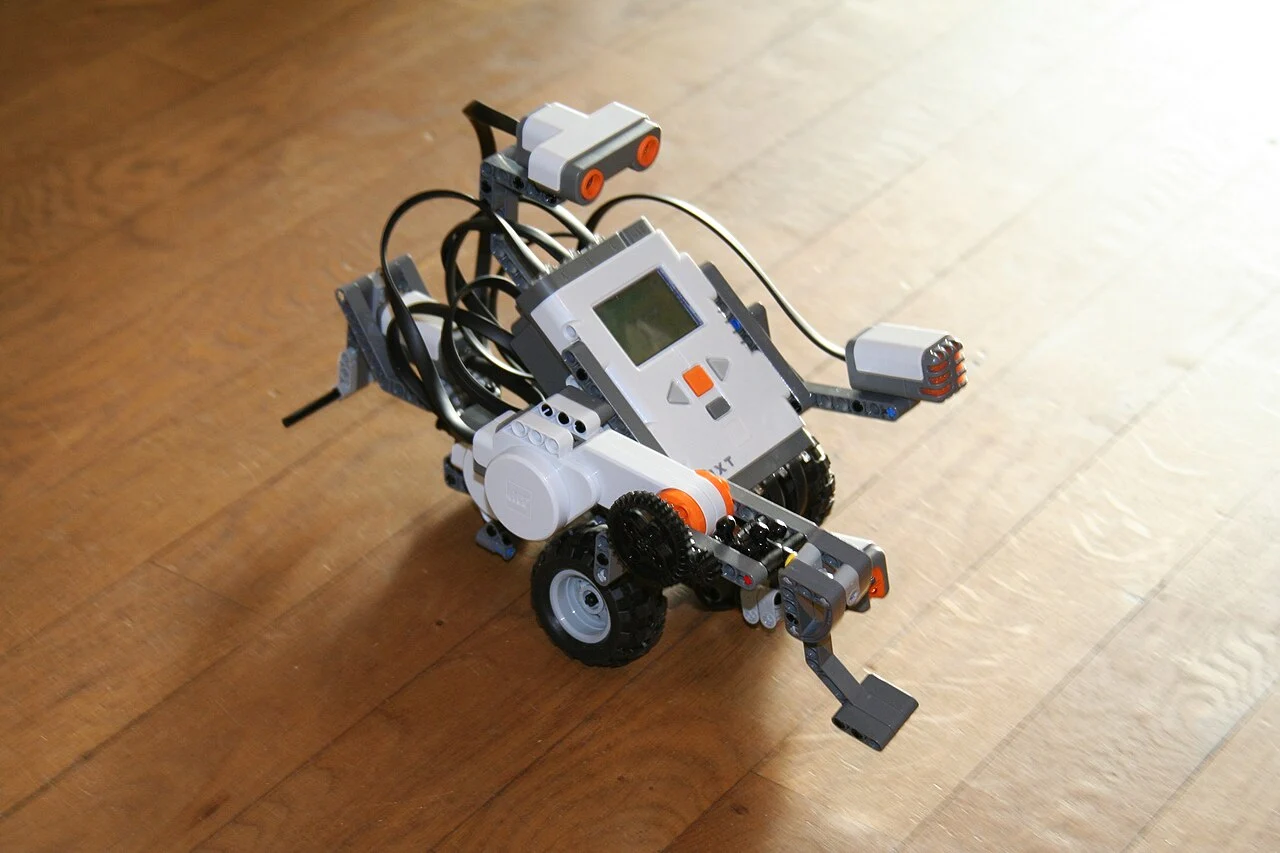
| LEGO Education SPIKE Prime | LEGO hub with motors and sensors | Classrooms, mechanisms and block-to-Python learning | Reliable construction system, structured lessons and fast iteration | Closed mechanical ecosystem and less exposure to wiring or power electronics |
| micro:bit mobile robot kit | BBC micro:bit plus vendor motor board | Young beginners and simple sensor projects | Low entry barrier and visual programming | Hardware quality, motor protection and documentation depend on the kit maker |
| Raspberry Pi robot kit | Raspberry Pi plus motor driver and sensors | Linux, networking, Python and computer vision | Full Linux environment and broad camera ecosystem | Power integrity, SD-card reliability and assembly can distract from the lesson |
| NVIDIA JetBot-style kit | Jetson module plus camera and mobile base | GPU-accelerated vision and learning experiments | CUDA ecosystem and camera inference examples | Exact software support depends on the Jetson generation and vendor image |
| TurtleBot 4 | Raspberry Pi 4 with Create 3 base and ROS 2 stack | ROS 2, SLAM, navigation and research education | Integrated odometry, sensors, charging and official ROS workflow | Higher price and complexity than beginner microcontroller kits |
Public prices and stock were checked on July 15, 2026. Import duties, batteries, shipping and institutional support are commonly separate.
Choose the learning objective before the kit
A kit for teaching circuits should expose pins, buses and current limits. A kit for teaching mechanisms should make it easy to change gear ratios and linkages. A kit for autonomy needs encoders, an inertial sensor and a range or vision sensor. A ROS 2 kit needs Linux compute, supported drivers, time synchronization and a documented frame tree.
Buying the most advanced platform can slow a beginner. A LiDAR-equipped robot introduces networking, drivers, calibration, transforms and navigation before the student understands motor direction. Start at the lowest layer that matches the goal, then add complexity after the robot can be tested.
Arduino Alvik compact embedded robotics
Arduino Alvik integrates drive motors, encoders and multiple sensors around a Nano ESP32-based controller. It supports Arduino programming and MicroPython workflows. The platform is suitable for line following, distance sensing, odometry basics and closed-loop movement without designing a motor board.
The advantage is a short path from code to motion. The limitation is scale. The small chassis cannot carry every camera or compute board, and students may learn less about wiring because much of the electronics is integrated. Use the expansion connectors to add one external sensor and document the interface.
LEGO SPIKE Prime rapid mechanical iteration
SPIKE Prime is effective when the lesson involves mechanisms, gear trains, linkages and repeatable classroom assembly. Students can rebuild the same hub and motors into a drive base, arm or sorting device. Block coding lowers the starting barrier, while Python provides a path toward text programming.
The closed construction system is also the limitation. Students do not select a motor driver, crimp a connector or diagnose ground noise. That is acceptable when the objective is computational thinking and mechanisms. Add measurement tasks such as repeatability, backlash and cycle time to make projects more engineering-focused.
micro:bit robot kits low cost with uneven quality
The BBC micro:bit offers buttons, LEDs, radio, accelerometer and a friendly programming environment. Many vendors sell two-wheel robots with line sensors, ultrasonic distance sensing and small servos. The kits work well for events and young students because a visible result appears quickly.
Compare the motor driver, battery holder, connector protection and documentation. Some boards lack clear current limits or use weak mechanical mounts. Check whether the battery is rechargeable and whether polarity can be reversed. A low price is not useful when the class spends its time repairing cables.
Raspberry Pi kits Linux and vision
A Raspberry Pi robot can run Python, OpenCV, web interfaces and ROS 2. It is a useful bridge from microcontrollers to robot computers. A camera project can detect colored objects, AprilTags or simple lines. Networking lets students inspect logs and deploy code remotely.
The Pi should not power motors directly. Use a dedicated motor driver and a power architecture that prevents motor current from resetting the computer. Protect the file system from sudden shutdowns. Document the operating-system image and package versions so the project can be rebuilt.
JetBot-style kits AI depends on the exact board
JetBot introduced a small camera robot around NVIDIA Jetson compute. Similar kits can run image classification, road following and collision-avoidance examples. The GPU makes neural-network inference accessible, but the word AI should not hide the training data and operating conditions.
Verify the Jetson model, memory, supported software release and camera. An old image may not install cleanly on a newer board. A notebook that works on a demonstration track may fail under different light or background. Save training images and test on a separate route.
TurtleBot 4 a ROS 2 learning system
TurtleBot 4 combines an iRobot Create 3 base, Raspberry Pi compute and ROS 2 support. Depending on the version, the platform includes sensors for mapping and navigation. It is designed for students who are ready to work with nodes, transforms, bags, SLAM and Nav2.
The price reflects integration and support rather than only hardware. It is excessive for a first blinking-light project but efficient for a lab that would otherwise integrate a base, encoders, battery charging, compute and sensors. Confirm the ROS distribution and package versions used by the course.
Hidden costs in beginner robot kits
Common omissions include batteries, a safe charger, microSD card, compute module, camera, LiDAR, cables, spare tires and tools. Institutional buyers may need storage cases, replacement parts and several identical chargers. Software can also require a cloud account or paid classroom management.
Budget for breakage. Small gearmotors, wheel hubs, jumper wires and connectors are consumables in a classroom. A kit with spare parts and published schematics can be cheaper over a semester than a sealed product with a low initial price.
A four-project progression
Project one should read one sensor and drive one actuator safely. Project two should use encoder feedback to move a measured distance. Project three should combine two sensors, such as line detection and obstacle ranging. Project four should add logging and a repeatable performance test.
Require a short report for each project wiring, software version, test setup, result and failure. The report should state whether movement was scripted, remote-controlled or based on sensor feedback. This habit prepares students for real robotics work better than a polished final video alone.
Limitations and missing information
- Kit bundles and included accessories differ by seller and region.
- Vendor examples can become outdated when operating systems and libraries change.
- Low-cost sensors may be inconsistent and should not be treated as calibrated instruments.
- Classroom-safe power levels do not remove pinch, short-circuit and battery risks.
- A kit that is ideal for one age group or learning goal may be poor for another.
Conclusion
Choose a kit by the layer you want to learn. Arduino Alvik is a compact embedded platform. LEGO SPIKE Prime supports fast mechanical iteration. micro:bit kits lower the entry barrier. Raspberry Pi and JetBot-style systems introduce Linux and vision. TurtleBot 4 is the clear step into ROS 2 navigation. The best purchase is the one that leaves time for measurement, debugging and explanation.
Frequently asked questions
What is the best robot kit for a complete beginner?
Arduino Alvik, LEGO SPIKE Prime or a well-documented micro:bit kit are strong starting points. Choose based on whether the lesson emphasizes electronics, mechanisms or simple programming.
Can a Raspberry Pi control motors directly?
No. Use a suitable motor driver and separate the motor power path from the computer. The Pi GPIO pins cannot supply motor current.
What kit is best for learning ROS 2?
TurtleBot 4 is a complete supported platform. A cheaper custom Pi robot can run ROS 2, but integration and driver work become part of the project.
Do I need LiDAR for a beginner robot?
No. Encoders, an IMU and a simple distance sensor teach more fundamental skills first. LiDAR is useful when the project reaches mapping and navigation.
What hidden costs should I check?
Batteries, charger, compute board, storage card, camera, sensors, shipping, import tax, spare motors and replacement cables.
Sources and methodology
The robotics kit review was refreshed on July 23, 2026 using Arduino, LEGO Education, Micro:bit Educational Foundation. Any quoted price or availability remains tied to country, configuration, tax, shipping, software and support conditions published by the seller.
Performance claims for robotics kit remain attributed to the named manufacturer or institution unless a separate test reproduces them. Unpublished payload, runtime, accuracy or service data is left blank.
Related TechniaHQRobot guides
Share this article
Share the current TechniaHQRobot article page.
Continue reading
Open the latest robotics reporting, Physical AI analysis and hardware notes.