
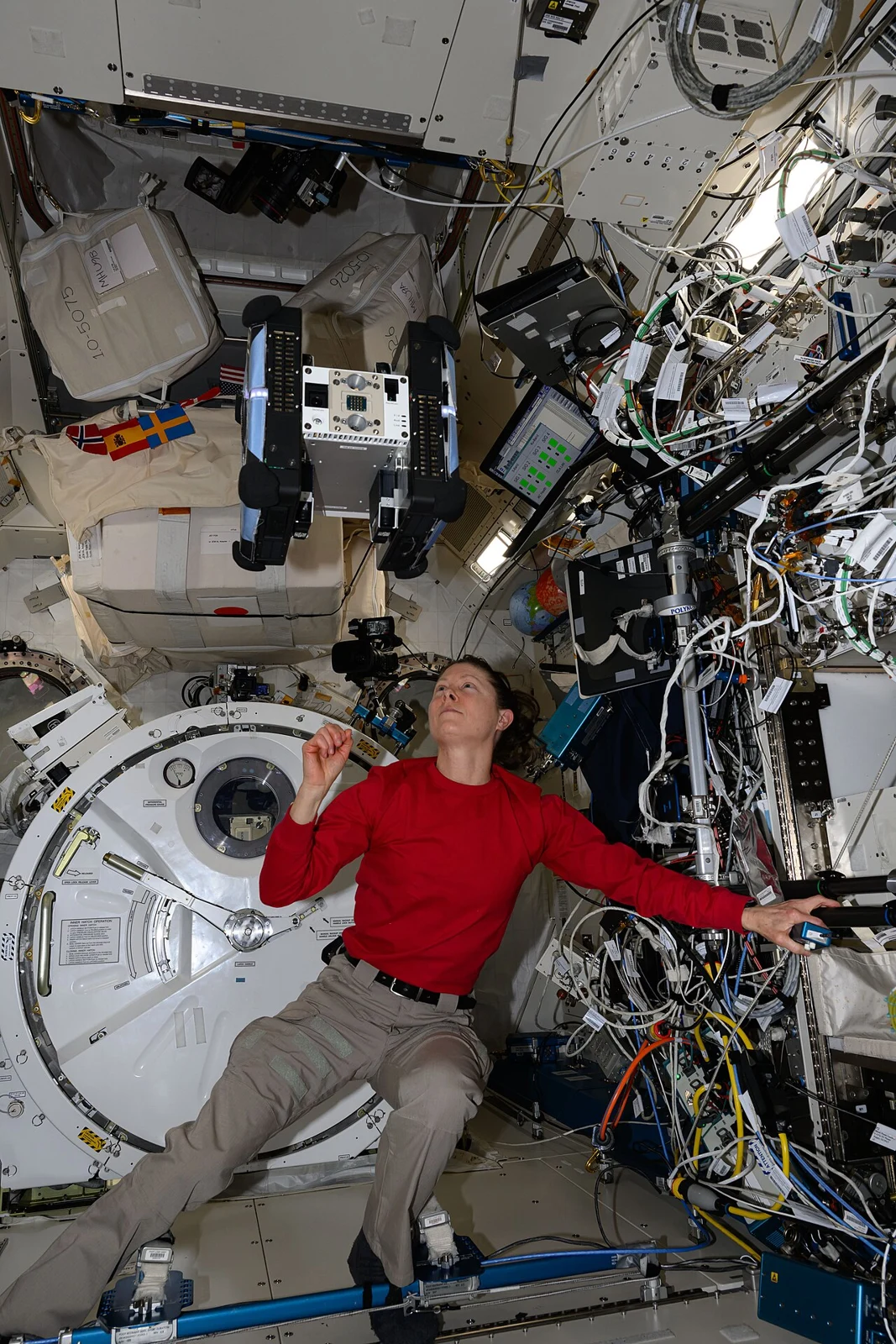
_---_NASA_astronaut_and_Expedition_71_Flight_Engineer_Tracy_C_Dyson_monitors_a_free-flying_Astrobee_robotic_assistant_inside_the_International_Space_Station%27s_Kibo_laboratory_module.jpg)
Introduction
A robotics engineer builds systems that sense, decide and move in the physical world. The work can focus on mechanisms, electronics, controls, perception, autonomy, integration or test. Nobody masters every layer at the same depth. The practical route is to build a broad foundation, choose one strong specialty and learn enough of adjacent disciplines to debug interfaces.
In 2026, a credible beginner path starts with Python and C++, Linux, linear algebra, basic mechanics, circuits and feedback control. ROS 2 provides the middleware used in many labs and products. Gazebo, MuJoCo or Isaac Sim help test ideas, but simulation cannot replace motor noise, loose connectors, wheel slip, calibration drift and safety limits. The portfolio should therefore include at least one physical robot and one detailed failure analysis.
Key findings
- Choose a primary track mechanical, electrical, controls, autonomy, perception, software platform or integration.
- Learn Python for rapid work and C++ for performance-sensitive and production robotics code.
- Use ROS 2 to understand nodes, messages, transforms, launch, parameters and tooling.
- Build one simple mobile robot before attempting a humanoid or dexterous manipulation project.
- Document failures, logs, test conditions and recovery instead of posting only a successful clip.
- Internships, research labs, open-source contributions and competition teams provide evidence that coursework alone cannot.
Robotics engineering roadmap by stage
The timeline is flexible. Progress is measured by systems you can explain and debug, not by months completed.
| Stage | Core knowledge | Visible project | Evidence to save |
|---|---|---|---|
| Foundation | Python, C++, Linux, Git, algebra, trigonometry, vectors and circuits | Microcontroller reads sensors and drives one actuator safely | Schematics, code, current limits and test video |
| Mobile robotics | Kinematics, encoders, IMU, PID, mapping and localization | Differential-drive robot follows a route and recovers from an obstacle | Rosbag, map, path error and intervention log |
| Perception | Camera models, calibration, OpenCV, depth and point clouds | Robot detects an object with measured false positives | Dataset, confusion matrix and lighting conditions |
| Manipulation | Forward and inverse kinematics, trajectory generation and grasping | Small arm reaches marked poses and moves a known object | Pose error, payload, cycle time and failure cases |
| Production practice | Testing, packaging, networking, safety, observability and deployment | Repeatable release installed on more than one robot | Version record, automated tests and rollback procedure |
Choose the kind of robotics engineer you want to become
Mechanical robotics engineers design links, joints, transmissions, housings, bearings and thermal paths. Electrical engineers design power distribution, motor drives, sensor interfaces, PCBs and wiring. Controls engineers model motion and close feedback loops. Perception engineers turn camera, LiDAR and tactile data into estimates. Autonomy engineers plan actions and recover from failure. Platform engineers make the software deployable, observable and secure.
Pick one track for depth but do not build a wall around it. A perception engineer should understand camera mounting and timestamp synchronization. A mechanical engineer should read motor telemetry. An embedded engineer should understand what ROS messages the application needs. Robotics rewards people who can cross one interface without pretending to be experts in every domain.
Build the mathematical foundation around real tasks
Linear algebra becomes useful when rotating a point cloud, transforming a camera pose or solving robot kinematics. Calculus appears in velocity, acceleration and optimization. Probability supports state estimation and sensor fusion. Differential equations and control theory explain how a motor, arm or balancing system reacts over time.
Do not study mathematics as an isolated checklist. Connect each topic to a program or experiment. Plot a two-dimensional rotation matrix. Estimate wheel odometry and compare it with measured distance. Tune a PID controller and record overshoot. Use a Kalman filter on noisy position data. The equation becomes memorable when its assumptions fail on hardware.
Programming stack Python, C++, Linux and Git
Python is effective for data inspection, computer vision experiments, scripting and quick ROS 2 nodes. C++ is common in real-time-adjacent control, perception pipelines, drivers and performance-sensitive libraries. Learn memory ownership, concurrency, build systems and debugging rather than only syntax. Robotics bugs often come from timing, stale state and incorrect units.
Linux is the normal development environment for ROS 2 and many robot platforms. Learn the shell, permissions, processes, networking, system logs and package management. Use Git branches and small commits. Add tests for geometry, message conversion and safety limits. A robot that moves is not enough; another engineer must be able to reproduce the build.
Electronics and embedded systems
Start with voltage, current, resistance, power and grounding. Learn why motors create electrical noise and why a logic board should not share power carelessly with a high-current actuator. Use a current-limited bench supply during bring-up. Understand pull-up resistors, level shifting, fuses, emergency stops and connector ratings.
Work with a microcontroller such as an Arduino-compatible board, STM32 or ESP32. Read an encoder, IMU or distance sensor. Drive a motor through a proper controller rather than directly from a pin. Inspect I2C, SPI, UART and CAN traffic. Embedded skill is valuable because many robot failures occur below the application software.
Mechanics, actuators and safe motion
Learn free-body diagrams, torque, gear ratio, backlash, stiffness, friction and tolerances. A motor selected only by peak torque can overheat during continuous operation. A gearbox can meet nominal load and still fail under shock. A printed bracket can flex enough to corrupt camera calibration.
Build a mechanism that moves under a defined load. Measure current, temperature and position error. Add hard stops and software limits. Keep hands away from pinch points and use low energy while tuning. Safe development is an engineering skill, not an administrative step added after the robot works.
ROS 2 and simulation
ROS 2 teaches distributed robot software through nodes, topics, services, actions, parameters and transforms. Start with the official tutorials, then create a small package that publishes sensor data and consumes commands. Learn ros2 topic, ros2 node, ros2 interface, ros2 bag, RViz and launch files. Understand Quality of Service because sensor streams and commands have different reliability needs.
Use Gazebo or another simulator to test coordinate frames, planners and control logic before touching hardware. Keep a boundary between simulated evidence and physical evidence. Perfect odometry, friction and latency can hide failures. Move the same node to a physical robot and compare logs rather than assuming the simulation result transfers.
The first portfolio robot
A differential-drive robot is a better first platform than a humanoid. It needs motors, encoders, a battery, a controller, mechanical structure and a safety strategy, but the kinematics are understandable. Add an IMU and a range sensor. Publish odometry in ROS 2, visualize transforms and command velocity through a limited interface.
Define one measurable task drive a rectangle, follow a corridor or navigate between two points. Record path error, run time, interventions and battery voltage. Then introduce a failure such as wheel slip or a blocked path and show how the system detects or recovers. This project demonstrates engineering judgment instead of assembly.
From projects to internships and jobs
Write each project like a short technical report. State the task, robot configuration, sensors, control mode, software version and test environment. Show the architecture, then explain one failure. Include code and logs when licensing allows. Avoid claiming autonomy when the robot follows a script or receives remote commands.
Target roles that match the strongest evidence in the portfolio. A candidate with motor control and embedded work should apply to controls, firmware and integration positions. A candidate with calibration, vision and datasets should target perception. Use job descriptions to identify repeated gaps, then build one project that closes the most common gap.
A twelve-month study sequence
Months one to three can cover Python, C++, Linux, Git, circuits and a microcontroller. Months four to six can add motors, encoders, PID control and a wheeled chassis. Months seven to nine can add ROS 2, transforms, logging and simulation. Months ten to twelve can focus on navigation or manipulation, testing and portfolio documentation.
The sequence should bend around available hardware and time. Do not delay projects until every prerequisite is complete. Build small systems, then revisit theory when a failure creates a specific question. That loop between model, code and hardware is the core of robotics engineering.
Limitations and missing information
- A roadmap cannot replace supervised lab safety and appropriate electrical or mechanical training.
- ROS 2 is common but not universal; companies may use proprietary middleware, PLCs or real-time systems.
- Simulation results can overstate performance when friction, latency, noise and wear are idealized.
- A degree helps with fundamentals and recruiting, but it does not guarantee hardware competence.
- Advanced research roles may require a master's degree or doctorate.
Conclusion
Learn robotics by closing the loop between theory and a physical system. Build a broad foundation, choose one deep specialty and document a robot that fails in visible ways and improves through testing. Employers can teach a specific platform more easily than they can teach disciplined debugging, safe motion and honest measurement.
Frequently asked questions
What degree is best for robotics engineering?
Mechanical engineering, electrical engineering, computer engineering, computer science, mechatronics and control engineering can all lead to robotics. Choose based on the work you want to do and add projects across interfaces.
Can I become a robotics engineer without a degree?
It is possible in software, technician, integration and maker-to-industry paths, but many engineering and research roles use a degree as a screening requirement. A strong portfolio and work history become essential.
Should I learn Python or C++ first?
Start with Python for rapid learning, then add C++. Production robotics frequently uses both. C++ is especially important for drivers, controls, perception and performance-sensitive code.
Is ROS 2 required?
No, but it is a valuable open ecosystem for learning distributed robot software. Industrial automation may use PLCs and proprietary stacks, while some products use custom middleware.
What is the best first robotics project?
A small differential-drive robot with encoders, an IMU and a distance sensor. It exposes mechanics, power, control, software, calibration and testing without the complexity of legs or hands.
Sources and methodology
The roadmap organizes study topics and proposed portfolio projects around software, mechanical, embedded and systems roles. The twelve-month sequence is an illustrative study plan.
Related TechniaHQRobot guides
Share this article
Share the current TechniaHQRobot article page.
Continue reading
Open the latest robotics reporting, Physical AI analysis and hardware notes.