

Introduction
The best robotics course depends on the job you want to perform. A beginner needs programming, linear algebra and hands-on projects. A ROS 2 developer needs Linux, C++ or Python, transforms and distributed debugging. An industrial engineer needs controller training, PLC interfaces and safety. A controls specialist needs dynamics, estimation and feedback. No single certificate proves competence across those roles.
This 2026 guide separates university courses, structured online programs, ROS training and manufacturer certification. Availability, duration and prices were checked on July 15, 2026 where public pages provided them. Free courses can teach rigorous material without issuing a recognized credential. Paid certificates can document completion without proving independent engineering skill. The strongest portfolio combines a defined curriculum with code, measurements and a robot or simulation project that can fail visibly.
Key findings
- Modern Robotics offers a structured six-course sequence in mechanics, planning and control with a published textbook and software exercises.
- MIT Underactuated Robotics is a demanding open course for dynamics and control, not a beginner certificate.
- Universal Robots Academy provides free e-learning plus classroom and virtual training tied to UR products.
- The Construct focuses on browser-based ROS and robotics training; course access and certificates depend on its current subscription or program terms.
- ABB, FANUC, KUKA and Yaskawa training is valuable when an employer uses that controller, but the credential is manufacturer-specific.
Robotics courses and training paths compared
Check the provider page for the exact cohort, language, certificate and regional price before enrollment.
| Course or provider | Format and level | Primary content | Credential and cost status |
|---|---|---|---|
| Modern Robotics, Northwestern on Coursera | Six-course online specialization; intermediate | Kinematics, dynamics, planning, control and capstone | Shareable certificate through Coursera; subscription pricing varies by country and plan |
| MIT Underactuated Robotics | Open university materials; advanced | Nonlinear dynamics, planning and feedback control | No general public professional certification promised on the open site |
| ROS 2 official tutorials | Free documentation; beginner to advanced | Nodes, topics, services, actions, packages and tools | No official completion certificate |
| The Construct | Browser-based courses and remote simulations; multiple levels | ROS 2, navigation, manipulation, Gazebo and robotics projects | Certificate and access depend on current course or subscription terms |
| Universal Robots Academy | Free e-learning plus paid instructor-led options | UR setup, programming, applications and service topics | UR-branded completion or certification path varies by training type |
| ABB, FANUC, KUKA or Yaskawa academies | Instructor-led manufacturer training | Controller programming, maintenance, safety and application packages | Manufacturer-specific certificate; regional price and schedule by training center |
A certificate of attendance is not the same as an accredited engineering license.
Define the target role before buying a course
Robotics roles are specialized. A perception engineer works with cameras, point clouds and machine learning. A motion-planning engineer works with geometry, optimization and collision checking. A controls engineer models dynamics and feedback. An industrial integrator configures frames, I/O, safety and process equipment. A field technician diagnoses hardware and restores production. The same course cannot prepare all five equally.
Write a job-shaped learning objective. “Build a ROS 2 mobile robot that maps an office and recovers from localization loss” is better than “learn robotics.” The objective determines prerequisites, software and evidence. A course should move the learner toward that output. If the syllabus has no programming assignments, measurements or debugging, it may provide vocabulary without building operational skill.
Foundation path for beginners
Begin with Python, basic C++, Linux command line, Git and numerical reasoning. Learn vectors, matrices, coordinate frames, trigonometry and probability at the level needed to interpret robot data. Electronics basics help with voltage, current, digital I/O and sensor interfaces. A small differential-drive robot or simulation can connect those topics without requiring expensive hardware.
A beginner project should include encoders, a distance sensor or camera, logging and a repeatable test. For example, command a robot to drive one meter, measure error over ten trials and explain wheel slip and calibration. That exercise teaches more than a choreographed path because it produces uncertainty that must be analyzed. Courses that encourage measurement and version control create better habits than tutorial copying.
Modern Robotics specialization
Northwestern University’s Modern Robotics specialization on Coursera follows the textbook by Kevin Lynch and Frank Park. The sequence covers rigid-body motion, forward and inverse kinematics, dynamics, trajectory generation, motion planning and control. Coursera listed it as a six-course intermediate specialization with an estimated four-month pace at about ten hours per week on the page checked July 15, 2026.
The program is mathematically structured and useful for engineers who want a coherent manipulator foundation. It is less focused on ROS 2 deployment, industrial controller programming or electronics. Learners should complete the programming exercises rather than watch videos only. The certificate records platform completion; the portfolio value comes from understanding frames, Jacobians, dynamics and controller behavior well enough to apply them to a different robot.
MIT Underactuated Robotics
Underactuated Robotics is an advanced open course associated with MIT. It studies nonlinear dynamics, control, optimization, planning and learning for systems such as legged robots, manipulators and flying machines. The notes and code are valuable for graduate-level study and experienced engineers. The material assumes comfort with differential equations, linear algebra, probability and programming.
This is not the fastest route to an entry-level ROS job. It is appropriate after foundations when a learner wants to understand why a controller stabilizes a robot or how trajectory optimization uses dynamics. The open materials do not promise a general professional certificate. Use the course for depth, reproduce examples and document an extension such as changing a cost function or evaluating a controller under model error.
Official ROS 2 tutorials
The ROS 2 documentation is the primary reference for creating workspaces and packages, using nodes, topics, services, actions, parameters and command-line tools. It also documents client libraries, launch, recording and middleware concepts. The tutorials are free and versioned by ROS distribution. Learners should choose the distribution used by their project and avoid mixing instructions across releases.
Official documentation is accurate but not a complete curriculum. It teaches mechanisms without always providing one sustained robot project. Pair it with a simulator and a goal such as mapping or manipulation. Learn transforms and timestamps early because many apparent algorithm errors are actually frame or synchronization problems. ROS 2 knowledge is demonstrated through maintainable packages, launch files and debugging, not a generic “ROS certified” claim.
The Construct and project-based ROS training
The Construct provides browser-accessible robotics courses and simulated robots, reducing local installation work. Its catalog includes ROS 2, navigation, manipulation and related tools. This can help learners who lack a suitable computer or robot. The platform also offers structured learning paths and enterprise training. Exact subscription prices, certificate conditions and course availability should be checked on the enrollment page.
The benefit of a hosted environment is rapid access. The limitation is that real deployments expose drivers, networks, GPU configuration and hardware faults that a managed simulator may hide. Export code to a local repository when permitted, read the underlying package documentation and repeat at least one project outside the guided environment. That step tests whether the skill transfers.
Universal Robots Academy
Universal Robots Academy offers free e-learning modules and instructor-led classroom or virtual training. The e-learning covers product setup, programming concepts and application topics in multiple languages. Instructor-led courses add guided exercises and access to training hardware. The value is highest for technicians and integrators who work with UR cobots because the material uses the real controller and Polyscope workflow.
UR training is manufacturer-specific. It does not replace general robot safety engineering, PLC skills or experience with other brands. Confirm whether a course is e-learning completion, classroom training or a certification path and what prerequisites apply. Regional training centers set dates and prices. Employers should match the course to the installed software generation and application package.
ABB, FANUC, KUKA and Yaskawa training
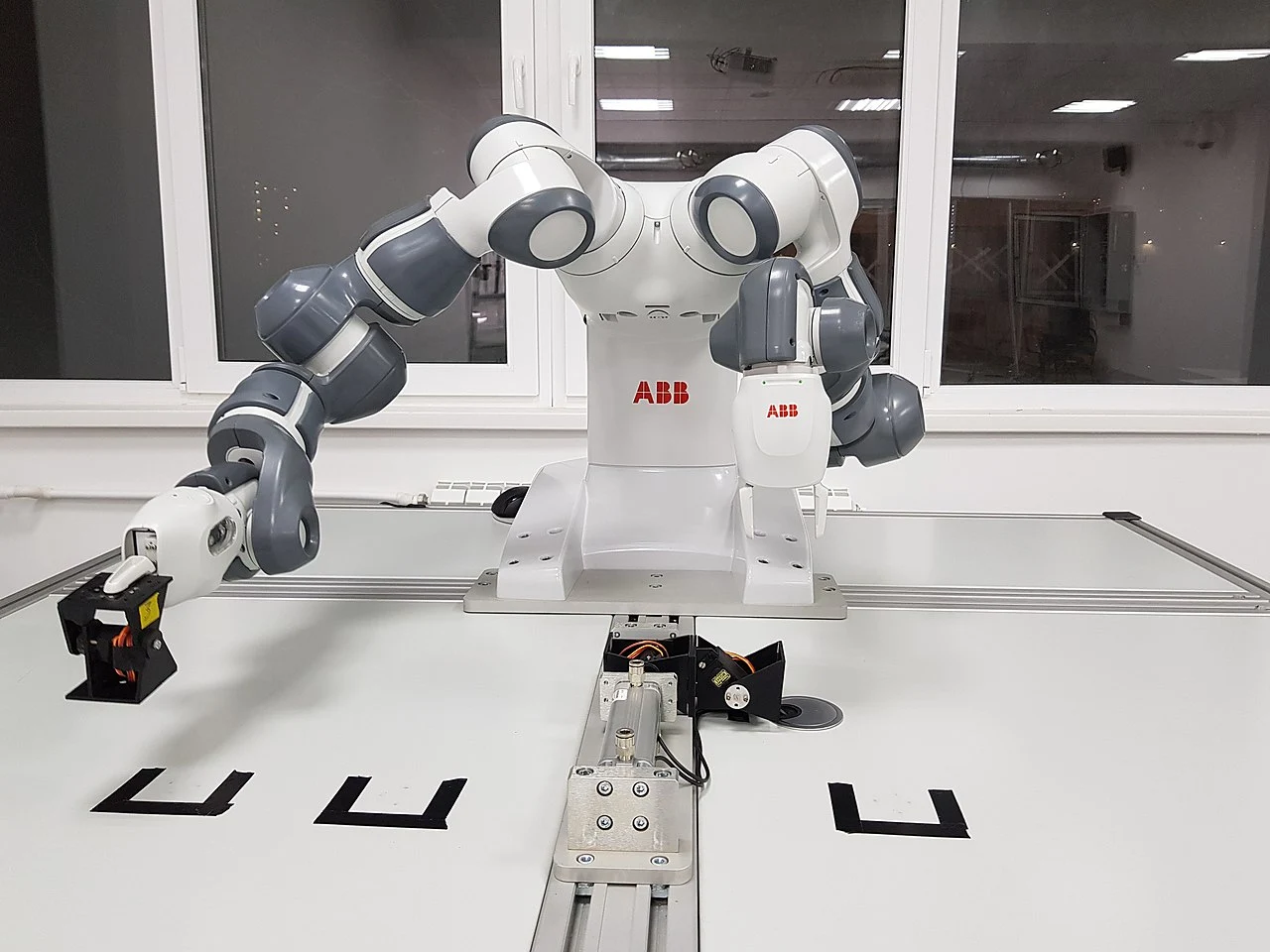
Manufacturer academies teach pendant operation, frames, motion, I/O, backups, maintenance and process packages. ABB courses use RAPID and RobotStudio. FANUC courses use TP programs, ROBOGUIDE and controller options. KUKA courses cover KRL and KUKA controller operation. Yaskawa courses cover INFORM and Motoman systems. Training often progresses from operator to programming, electrical maintenance and advanced applications.
These certificates show exposure to a named product course. They do not create cross-brand fluency automatically. The strongest return occurs when the learner can practice immediately on the employer’s equipment. Before booking, verify robot family, controller generation, course language, duration, included materials and whether the assessment is practical. Travel and production coverage can cost more than tuition.
Safety training and standards
Robot safety education should cover risk assessment, safeguarding, collaborative applications, stopping distance and validation. A3 and other standards organizations provide training around industrial robot safety, while manufacturers teach their safety configuration tools. The underlying standards can include ISO 10218, ISO/TS 15066 and regional requirements. Course completion does not authorize someone to sign every safety validation; competence includes relevant experience and organizational responsibility.
Choose a course that distinguishes robot safety functions from the safety of the complete application. A safe-speed option does not address a sharp tool or hot process. Practical training should include protective devices, reset logic, manual modes and validation evidence. Engineers working on mobile robots need the appropriate mobile-robot safety standards rather than relying only on fixed-cell training.
Simulation courses and tools
Gazebo and related simulators help test sensors, ROS 2 integration and robot behavior. Manufacturer tools such as RobotStudio, ROBOGUIDE, KUKA.Sim and MotoSim focus on their robot controllers and cells. NVIDIA Isaac Sim and other platforms add high-fidelity rendering and synthetic data workflows. A learner should choose the simulator connected to the target job rather than attempting every tool.
Simulation skill includes model validation. Check joint limits, inertia, friction, sensor rates and controller assumptions. A model that runs is not necessarily accurate. Build one comparison between simulated and measured motion when hardware is available. Document the mismatch and its impact on control or perception. That exercise turns simulator familiarity into engineering evidence.
How to judge a certification
Check who issues the credential, what assessment is required and whether the provider claims accreditation. A platform certificate may verify completion. A manufacturer certificate may document product training. A university credit course may carry academic credit. These are different signals. Avoid describing a private certificate as a government license or universal professional certification unless the issuing body explicitly supports that claim.
Employers should inspect the project behind the credential. Ask the candidate to explain a frame error, tune a controller or recover a robot from a fault. Learners should publish a concise repository with requirements, architecture, test data and limitations. A certificate can open the conversation; technical decisions and measured results sustain it.
A twelve-month engineering plan
Months one to three can cover Python, Linux, Git, mathematics and a small simulated robot. Months four to six can add C++, ROS 2, transforms and sensor integration. Months seven to nine can focus on one specialization navigation, manipulation, controls, perception or industrial automation. Months ten to twelve should deliver a substantial project with testing, documentation and a failure analysis.
Add manufacturer training only when it matches accessible hardware or a near-term job. Use an advanced controls course after the mathematics is ready. Review job descriptions in the target region and map repeated requirements to projects. The plan should end with evidence code, diagrams, logs, a demo and a written explanation of what the robot could not do.
Limitations and missing information
- Course catalogs, prices and schedules change; every enrollment detail must be rechecked on the provider page.
- Completion certificates do not prove professional licensure, safety authority or independent engineering competence.
- Hosted simulations can hide hardware, networking and driver problems found in real robots.
- Manufacturer credentials are valuable but tied to a controller ecosystem.
- Free documentation may be technically excellent while offering no certificate or instructor feedback.
Conclusion
The strongest 2026 robotics learning path combines foundations, one coherent theory course, ROS 2 practice and a specialization tied to real work. Modern Robotics builds manipulator fundamentals. MIT Underactuated develops advanced controls depth. Official ROS 2 documentation and The Construct support software practice. Manufacturer academies matter for industrial equipment. Select by job output, verify the credential and finish with measured project evidence.
Frequently asked questions
What is the best robotics course for beginners?
Start with Python, Linux, basic mathematics and a project-based introductory robotics course. Add ROS 2 after you can write and debug simple programs.
Is there an official ROS 2 certification?
Open Robotics provides official documentation, but it does not present the standard tutorials as a universal professional certification. Private providers may issue their own completion certificates.
Are Coursera robotics certificates recognized?
They document completion of the platform program. Recognition depends on the employer. The technical value is stronger when paired with completed assignments and projects.
Which course is best for industrial robot programming?
Take the manufacturer course for the controller used by the employer, such as ABB, FANUC, KUKA, Yaskawa or Universal Robots, plus PLC and safety training.
Can simulation courses replace a real robot?
They can teach planning, software and debugging, but real hardware adds calibration, timing, wear, safety and unpredictable faults. Use both when possible.
Sources and methodology
Evidence for best robotics courses was rechecked on July 23, 2026 against Northwestern University and Coursera, MIT, Open Robotics. Time-sensitive prices, permits, service areas and certifications stay dated, and a missing supplier value is not converted into an official specification.
Related TechniaHQRobot guides
Share this article
Share the current TechniaHQRobot article page.
Continue reading
Open the latest robotics reporting, Physical AI analysis and hardware notes.