

Introduction
Autonomous delivery robots cover two distinct vehicle classes. Starship, Serve Robotics and Kiwibot operate small sidewalk machines that carry food or parcels at low speed. Nuro has developed road-going zero-occupant vehicles and now also licenses autonomy technology. These robots can navigate substantial portions of a route without an onboard driver, but they still rely on mapped operating areas, remote assistance, fleet teams and local permission.
A responsible comparison separates navigation autonomy from remote intervention and commercial service. A robot may plan around pedestrians autonomously, then request a remote operator at a blocked curb. A company may announce a partnership before regular customers can order. Sensor and payload details also change by generation. This guide uses official company material and public regulatory reporting available on July 15, 2026 and marks unpublished values rather than filling gaps.
Key findings
- Sidewalk robots and road vehicles operate under different speed, mass, regulatory and safety constraints.
- Starship has one of the longest-running public sidewalk delivery operations, especially on university campuses and selected cities.
- Serve uses a sidewalk delivery platform with autonomous navigation and remote supervision in commercial partnerships.
- Nuro’s purpose-built road vehicle program differs from sidewalk delivery and its business has increasingly included licensing its autonomy stack.
- Kiwibot operates compact delivery robots with remote operational support; exact autonomy and intervention rates are not publicly standardized across deployments.
Starship, Serve, Nuro and Kiwibot compared
Manufacturers do not publish every sensor model, payload or intervention statistic for every active generation.
| Company | Vehicle class | Typical sensor categories | Human operational role |
|---|---|---|---|
| Starship Technologies | Six-wheel sidewalk delivery robot | Cameras, ultrasonic sensing, radar and other localization or safety sensors described across product generations | Remote assistance can support unusual situations; local teams recover or service robots |
| Serve Robotics | Four-wheel sidewalk delivery robot | Cameras, LiDAR and additional onboard sensing described by the company | Remote supervision and intervention are part of fleet operations |
| Nuro | Road-going zero-occupant delivery vehicle and autonomy platform | Cameras, radar and LiDAR on purpose-built vehicle generations | Fleet operations and remote support remain part of deployment; business model now includes autonomy licensing |
| Kiwibot | Four-wheel sidewalk delivery robot | Camera-led sensing with additional localization and safety hardware varying by generation | Remote operators and field teams support deployments |
Check the local service page because a company can be active in one campus while absent from the surrounding city.
What “autonomous delivery” means
Navigation autonomy means the onboard system can perceive the route, estimate its position, plan motion and control the vehicle without continuous steering by a person. It does not mean the fleet operates without humans. Remote staff can confirm a path, help after a blockage or take a more active role depending on the system. Field teams charge, clean, repair and recover robots. Merchants load compartments and customers retrieve orders.
Autonomy should be described by the dynamic task and operating domain. A sidewalk robot at walking speed on a mapped campus is not equivalent to a road vehicle mixing with cars. A pilot with a remote operator handling many crossings is not equivalent to mature autonomous service. Companies rarely publish intervention rates in a common format, so comparisons should avoid unsupported percentages.
Starship Technologies
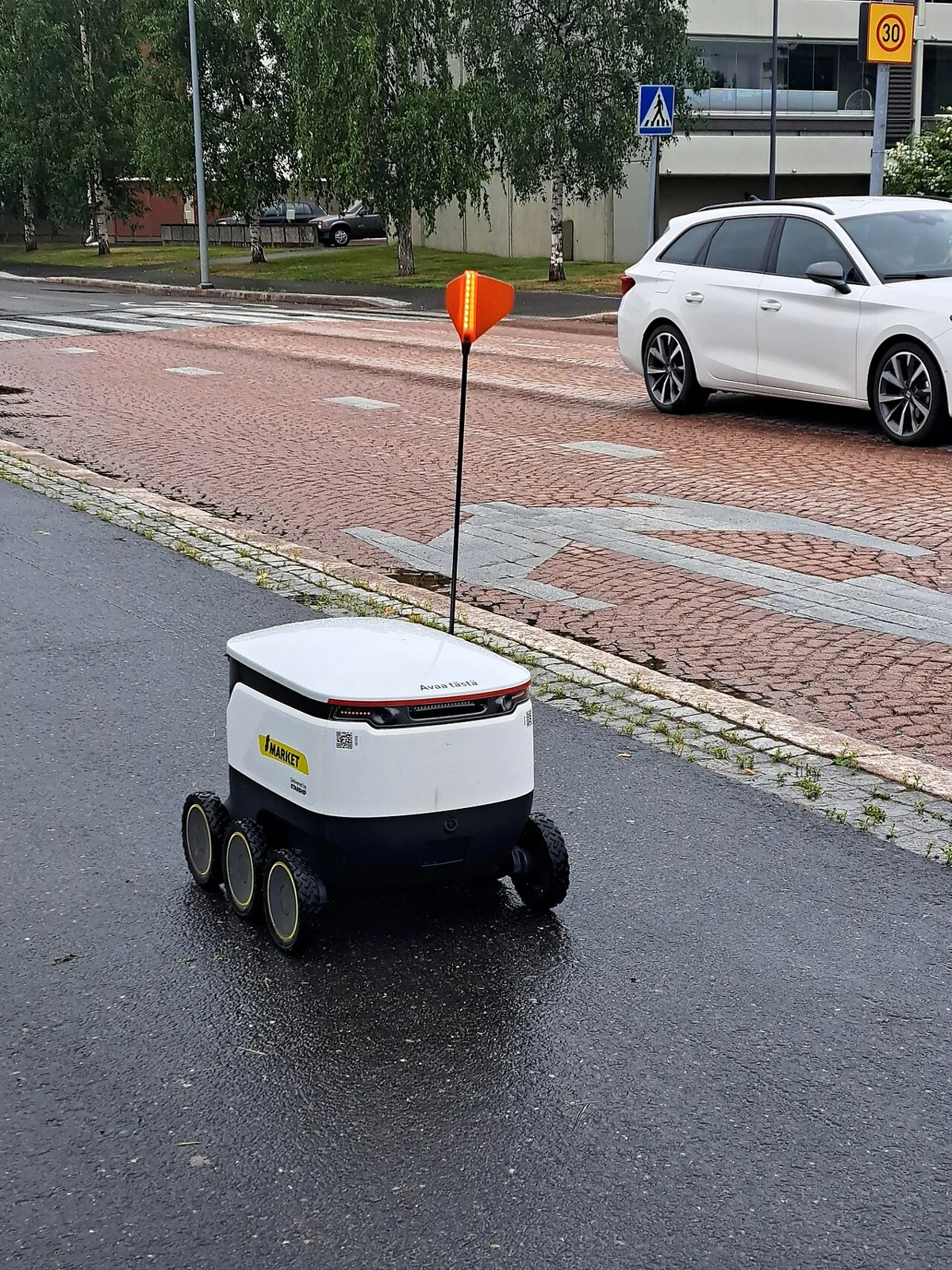
Starship uses compact six-wheel robots designed for sidewalks and pedestrian environments. The locked cargo compartment is opened by the customer through the service workflow. The company has deployed on university campuses and in selected communities, where structured routes, local operations and repeated mapping support service. Low speed and small mass reduce kinetic risk compared with road vehicles but do not remove curb, pedestrian and accessibility challenges.
The platform uses multiple sensor modalities across generations, with company descriptions including cameras, ultrasonic sensing and radar. GNSS and map-based localization can support global position while onboard perception handles nearby obstacles. Remote assistance is available for ambiguous situations. Exact payload, battery runtime and sensor model should be checked for the deployed generation because public values from older robots may no longer describe the active fleet.
Serve Robotics
Serve Robotics operates four-wheel sidewalk delivery robots and has commercial partnerships with delivery platforms and merchants. The robot carries an order in a secured compartment and travels on sidewalks inside supported service areas. Company materials describe autonomous navigation using cameras, LiDAR and other sensors, with remote supervision available. Public deployment announcements need to be separated from the number of robots actively serving customers on a given day.
Serve’s business depends on fleet utilization and merchant integration as much as navigation. Robots need orders concentrated within viable distances, loading procedures and customer handoff. Sidewalk speed, crossing behavior and curb access influence trip time. A fleet can technically navigate a neighborhood but still be uneconomic if it waits too long at restaurants or needs frequent human recovery.
Nuro and road-going delivery
Nuro developed purpose-built zero-occupant vehicles intended to carry goods on public roads. The vehicle class is larger, faster and more regulated than a sidewalk robot, requiring perception and behavior for lanes, intersections and other road users. Nuro’s public strategy has evolved toward licensing its autonomy technology as well as developing delivery vehicles. The current commercial role should therefore be checked separately from earlier grocery-delivery pilots.
Road operation changes the safety case. Cameras provide semantics, radar measures velocity and LiDAR supplies geometry. Redundant braking, steering and compute become important when there is no driver. Remote support and fleet response still exist. A permit or announced partnership does not prove broad customer availability. Confirm the active geography, vehicle generation and whether operation is testing, paid delivery or technology licensing.
Kiwibot
Kiwibot deploys compact four-wheel robots for campus and urban food delivery. Its system combines onboard autonomy with remote operational support. The company has used different robot generations, so photographs and specifications from one program should not be assumed for all current deployments. The service depends on local merchant integration, mapped routes and field support.
Remote assistance is especially relevant at crossings, construction zones and blocked sidewalks. The exact boundary between high-level guidance and direct control should be stated from current company documentation when available. Without a published intervention metric, the correct description is supervised autonomy with human support, not an invented autonomy percentage.
Cameras, LiDAR, radar and ultrasonic sensors
Cameras identify traffic participants, signals, curb edges and semantic context. LiDAR provides direct range geometry and can help around low-contrast objects. Radar measures relative velocity and can operate in lighting conditions that challenge cameras. Ultrasonic sensors cover short-range proximity. GNSS gives global position outdoors but can degrade near buildings or trees. Wheel encoders and IMUs support local motion estimation.
No sensor makes the robot autonomous alone. The system needs calibration, synchronization, localization, prediction and motion planning. Small robots face low sensor height, which can create occlusion behind parked cars or street furniture. Lenses and LiDAR windows collect dirt and rain. A production fleet needs health monitoring and behavior that stops or requests help when sensing quality falls.
Curbs, crossings and sidewalk geometry
Curbs are a defining mechanical constraint. Many sidewalk robots cannot climb a standard curb and therefore depend on curb ramps. Parked vehicles, snow, bins or construction can block the ramp. Wheel diameter, suspension, ground clearance and center of gravity determine which cracks and slopes are passable. A route that works in dry weather may fail after debris or ice changes traction.
Crossings require perception, traffic prediction and local legal compliance. A low robot can be difficult for drivers to see. Remote assistance may be used when the onboard system lacks confidence, but communications delay and human workload must be managed. Fleet planners often choose routes that avoid difficult crossings rather than demonstrating unrestricted mobility.
Payload, compartment and customer handoff
Payload is limited by vehicle size, stability, battery and braking. Food delivery values insulation and spill control; parcel delivery values volume and security. A published maximum payload does not describe the typical order. Heavy loads can reduce range and alter stopping. The compartment needs tamper resistance, cleaning and a reliable lock that opens for the correct customer.
Handoff is part of the robot system. The merchant must load the correct order and close the compartment. The customer must locate the robot and unlock it through the app. Accessibility matters for people who cannot bend or reach the lid. Failed unlocks create support calls even when navigation was perfect. Service design should measure the complete order, not only robot miles.
Battery and fleet operations
Energy use depends on distance, speed, payload, temperature, stops and compute. Robots can return to a base for charging or be swapped and serviced by field staff. Public battery claims should be interpreted under their test conditions. A delivery fleet needs enough reserve to avoid stranding and enough chargers to handle peaks. Charging downtime reduces utilization.
Operations teams monitor robots, respond to faults, update maps, clean sensors and retrieve disabled units. Theft and vandalism are also fleet risks. Remote support software, cellular data and local depots create recurring cost. A company can demonstrate autonomous navigation while still relying on substantial manual logistics to keep the service running.
Commercial availability and regulation
Availability is hyperlocal. Starship can be broadly used on one campus and unavailable a kilometer away. Serve service depends on active delivery-platform zones. Kiwibot deployments are tied to partner locations. Nuro road operations depend on vehicle and jurisdiction. State or municipal rules can specify weight, speed, identification and operator responsibilities for personal delivery devices.
Check the ordering app, partner page and local authority for current access. An announced city may be in mapping or pilot stage. A permit may allow testing but not paid delivery. A partnership may begin with a small fleet. The article date matters because these programs open, pause or change boundaries quickly.
Safety and accessibility
Low-speed robots reduce impact energy but can obstruct sidewalks, ramps or tactile paving. Safe behavior includes yielding, maintaining clearance, controlling speed near people and stopping predictably. Lighting, flags or sound can improve visibility. The fleet needs procedures for emergency responders and for a robot blocking access after a fault.
Accessibility evaluation should include wheelchair users, people with visual impairments and crowded sidewalks. A robot that parks on a curb ramp creates a real barrier. Companies and cities can use geofenced no-stop zones, route rules and field audits. Safety reporting should include obstruction and intervention events, not only collisions.
How to compare a delivery robot deployment
Ask for the exact vehicle generation, operating domain, maximum and typical payload, sensor categories, remote-assistance policy and local service status. Request mission completion, intervention, recovery and on-time delivery metrics with definitions. Separate autonomous distance from distance under direct remote control. Inspect weather and nighttime limits.
For economics, measure orders per robot-hour, merchant wait, average distance, charging, support labor and failed handoffs. A robot is valuable when it completes customer orders reliably, not when it accumulates empty demonstration miles. Compare it with bicycle couriers, cars, lockers and pickup using the same service area and order density.
Limitations and missing information
- Exact sensor models, payloads, battery runtime and intervention rates are not published consistently across companies or generations.
- Commercial availability changes by campus, neighborhood, delivery partner and local regulation.
- Autonomous navigation still depends on remote support, field recovery, charging and merchant loading.
- Low speed reduces but does not eliminate collision, obstruction and accessibility risks.
- Announced partnerships and permits are not counted as broad customer service without active ordering access.
Conclusion
Starship, Serve and Kiwibot show how low-speed sidewalk robots can automate part of the last mile inside bounded areas. Nuro addresses the harder road-vehicle domain and increasingly supplies autonomy technology as well as vehicles. The decisive comparison is local vehicle generation, permitted route, remote-intervention model, completed-order reliability and field support. No current delivery fleet operates without people around the autonomy stack.
Frequently asked questions
Are delivery robots fully autonomous?
They can navigate autonomously for much of a route, but fleets retain remote assistance, monitoring, maintenance and field recovery. The exact intervention mode varies.
Can sidewalk robots climb curbs?
Most depend on curb ramps and have limited obstacle height. Wheel size and suspension vary, so route planning avoids unsupported curbs.
Which delivery robot has six wheels?
Starship’s familiar sidewalk platform uses six wheels. Serve and Kiwibot commonly use four-wheel sidewalk designs, while Nuro uses a road-vehicle architecture.
Does Nuro operate on sidewalks?
Nuro’s purpose-built delivery vehicles are designed for roads, which is a different operating domain from small sidewalk robots.
How do customers open the robot?
The delivery workflow typically authenticates the customer through an app or service and unlocks the secured compartment at the destination.
Sources and methodology
Evidence for autonomous delivery robots was rechecked on July 23, 2026 against Starship Technologies, Serve Robotics, Nuro. Time-sensitive prices, permits, service areas and certifications stay dated, and a missing supplier value is not converted into an official specification.
Related TechniaHQRobot guides
Share this article
Share the current TechniaHQRobot article page.
Continue reading
Open the latest robotics reporting, Physical AI analysis and hardware notes.