

Introduction
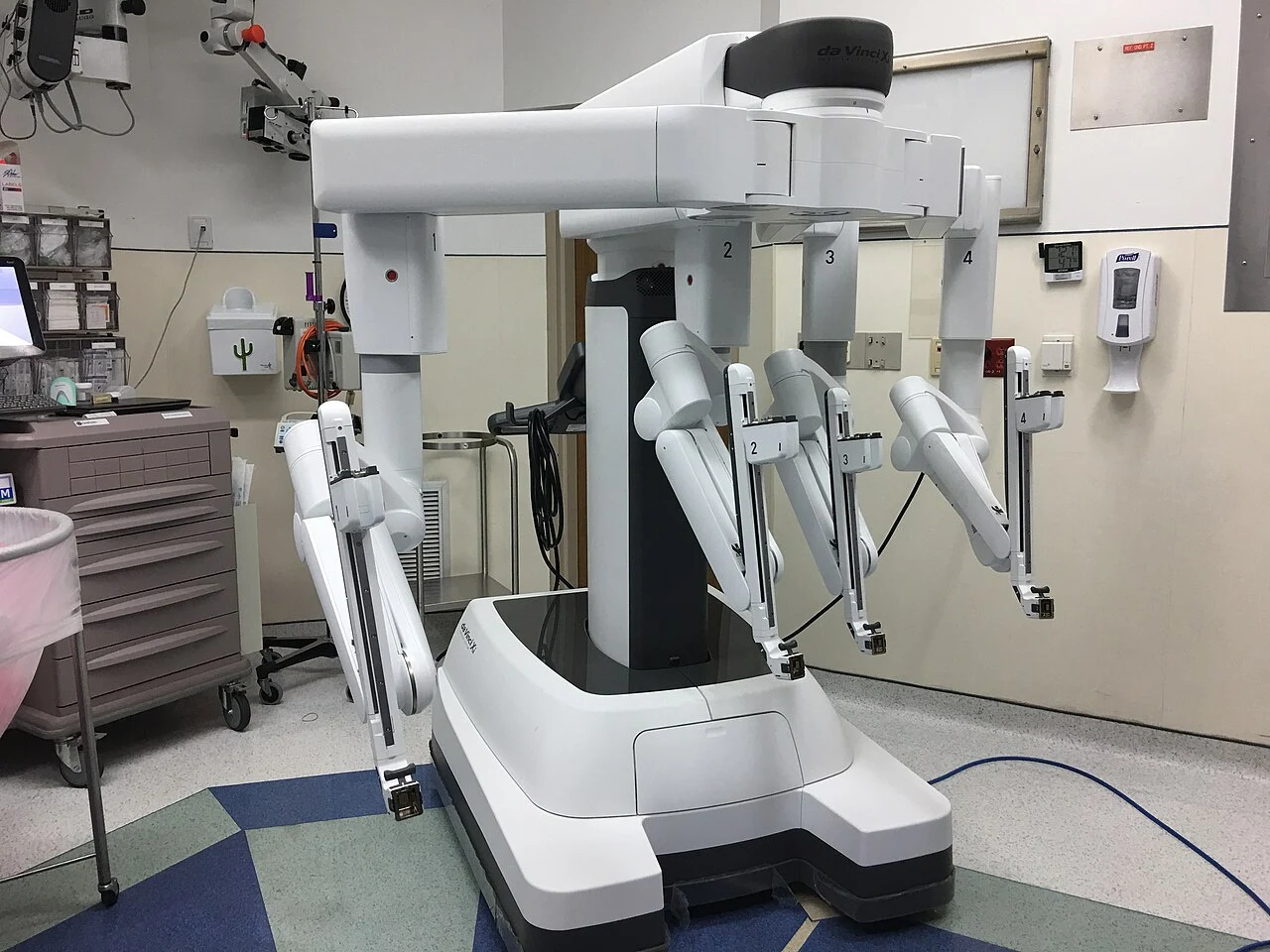
The Da Vinci surgical robot is a surgeon-controlled platform for minimally invasive procedures. It does not select an operation, make clinical decisions or move instruments without direct human input. The surgeon sits at a console and controls articulated instruments mounted on bedside arms while viewing a magnified stereoscopic image. A trained team at the patient side exchanges instruments, manages access ports and can convert the procedure when required.
Cost is broader than the acquisition price. Hospitals budget the system, instruments with limited use cycles, service, training, operating-room time and workflow changes. Intuitive Surgical generally sells through quotations, so a single current global list price is not published for every configuration. This guide explains the architecture, benefits and limitations, then compares alternatives only at the level supported by official or regulatory information available on July 15, 2026.
Key findings
- Da Vinci is a master-slave surgical system the surgeon remains in control of every instrument movement.
- The platform combines a surgeon console, a patient-side cart and a vision or processing cart, with configuration varying by generation.
- Articulated EndoWrist instruments reproduce wrist-like motion inside the body and the control system can scale motion and filter tremor.
- Clinical value depends on procedure, surgeon experience, hospital volume and comparison with conventional laparoscopy or open surgery.
- Acquisition, service and disposable or limited-life instruments create recurring costs that cannot be judged from the robot purchase alone.
Robot-assisted surgical platforms compared
This comparison separates control architecture and clinical category. “Surgical robot” covers systems that perform very different tasks.
| System | Control model | Platform focus | Commercial status and limits |
|---|---|---|---|
| Intuitive da Vinci 5 | Surgeon controls instruments from a console | Multiport minimally invasive surgery with force feedback and integrated data features | Commercial in supported markets and indications; procedure and regional approvals apply |
| Intuitive da Vinci SP | Surgeon-controlled single-port platform | Single incision access for selected procedures | Available for cleared indications; not interchangeable with every multiport procedure |
| Medtronic Hugo RAS | Surgeon console with modular arm carts | Multiport soft-tissue procedures | Availability and indications vary by country; US regulatory status must be checked by procedure |
| CMR Versius | Surgeon-controlled modular bedside units | Portable modular soft-tissue surgery workflow | Commercial in multiple markets; FDA clearance began with specified procedures rather than universal use |
| Zimmer Biomet ROSA systems | Surgeon-planned and controlled orthopedic assistance | Knee, hip, brain or spine workflows depending on product | Different robot category supports planning and instrument guidance rather than da Vinci-style soft-tissue manipulation |
No system in this table independently decides or performs an operation.
What the Da Vinci system contains
The surgeon console provides hand controls, foot pedals and a stereoscopic viewer. The console translates the surgeon’s hand motion into commands while allowing motion scaling and tremor filtration. The patient-side cart carries the camera and instruments through ports placed by the surgical team. A vision or processing cart manages imaging and communication. Newer generations add integrated displays, workflow data and simulation functions, but the central control relationship remains direct surgeon operation.
The bedside team is essential. Staff position the patient, create access, dock the arms, insert and exchange instruments, manage insufflation and respond to events that the console surgeon cannot physically address. An assistant may suction, retract, staple or pass material through an accessory port. The robot increases instrument dexterity at the operative site; it does not replace anesthesia, nursing, sterile processing, pathology or the clinical judgment of the operating surgeon.
How hand motion becomes instrument motion
At the console, sensors measure the surgeon’s hand and finger movements. Software maps those inputs to the selected instrument, scales movement and suppresses small involuntary tremor. The instrument wrist can pitch, yaw and rotate beyond the motion available from a rigid laparoscopic tool. This articulation is valuable in confined anatomy where suturing or dissection requires changing approach angles without enlarging the incision.
The mapping is not autonomous planning. The system does not recognize a tissue plane and decide to cut it. The surgeon interprets the image, chooses the instrument and commands each action. Safety features can constrain or stop motion when the system detects limits, communication faults or instrument conflicts, but those controls are not a substitute for anatomical knowledge. The US FDA explicitly describes robotically assisted surgery as direct human control.
Vision, depth and force information
Da Vinci systems provide magnified high-definition stereoscopic imaging. Two optical channels give depth perception that conventional two-dimensional laparoscopy may not provide, although many modern laparoscopic systems also offer excellent 3D visualization. The camera is controlled through the console, allowing the operating surgeon to frame the field. Image quality still depends on lens cleanliness, smoke, bleeding, lighting and correct scope positioning.
Da Vinci 5 introduced force-feedback capabilities for supported instruments, giving the surgeon measured force information that earlier generations did not return through the hand controls. Force feedback can help training and tissue handling, but it does not make tissue properties perfectly transparent. Surgeons still rely heavily on visual deformation and experience. Force sensing is generation- and instrument-dependent, so hospitals should verify which instruments and software functions are included in the purchased configuration.
Procedures and indications
Da Vinci platforms are used in urology, gynecology, general surgery, thoracic surgery and other specialties under specific clearances and hospital privileges. Prostatectomy and hysterectomy are widely associated with robotic surgery, while hernia repair, colorectal procedures and selected thoracic operations are also performed. The existence of a robotic technique does not mean it is appropriate for every patient. Anatomy, prior surgery, disease stage, surgeon expertise and emergency circumstances influence the approach.
Regulatory indications matter. A hospital cannot infer that a platform cleared for one anatomy or procedure has universal approval. The FDA advises patients to discuss the surgeon’s experience and alternatives. For cancer procedures, long-term outcomes can depend on tumor type and technique; a smaller incision alone does not establish equivalent oncologic results. Published evidence should be read by procedure, comparator and endpoint rather than treated as one verdict on “robotic surgery.”
Potential benefits and where they come from
Robot assistance can improve instrument articulation, camera stability, ergonomic posture and access through small ports. Those features may reduce blood loss, incision size or hospital stay for some operations compared with open surgery. The right comparator is important. Benefits can be smaller when compared with expert conventional laparoscopy, which is already minimally invasive. Outcomes also improve as teams standardize docking, instrument exchange and emergency conversion.
Ergonomics can matter for surgeons who otherwise spend long procedures standing with constrained neck and wrist positions. The console permits seated operation and controlled hand posture. Yet console comfort does not remove cognitive workload. The surgeon monitors anatomy, energy use, arm positions and team communication while lacking direct contact with the patient. A well-designed robotic program trains the whole team, not only the console operator.
Risks and failure modes
Robotic surgery carries the general risks of the operation plus platform-specific concerns. Docking and port placement can cause collisions or restricted access. Instrument insulation damage or energy misuse can injure tissue. A mechanical or communication fault may require undocking or conversion. Long procedures can increase anesthesia time or positioning risk. These events are managed through preventive maintenance, checklists, credentialing and rehearsed emergency procedures.
The robot can also create false confidence. Magnification makes small motion visible but does not guarantee correct tissue identification. Limited haptic information in many generations means excessive force may be recognized mainly from visual cues. Bedside access can be slower after docking. Hospitals need a conversion plan, available laparoscopic or open instruments and personnel who can respond quickly. The system should be treated as a complex surgical tool, not an independent safety layer.
Acquisition and recurring cost
Intuitive does not publish one universal 2026 price for every Da Vinci configuration. Public filings and historical hospital disclosures show that capital cost can reach well into seven figures, but a current project requires a formal quotation. The quote should identify the system generation, consoles, instruments, imaging options, warranty, service term, installation and training. Facility changes and financing may sit outside the supplier agreement.
Recurring cost includes instruments and accessories, some of which have defined use limits, sterile drapes, service contracts and staff time. Case volume changes the cost per procedure because fixed capital and service expenses are spread over more cases. High volume alone does not guarantee value; the program needs suitable procedures and outcomes. A hospital business case should compare total episode cost, operating-room time, length of stay, complications and the alternative equipment already owned.
Training, credentialing and the learning curve
Manufacturer training can include online modules, simulation, system practice and supervised clinical progression. Hospital credentialing is separate. Institutions define privileges, proctoring and case requirements based on specialty and local governance. A certificate showing completion of product training is not identical to independent evidence of surgical competence. Surgeons also need procedure-specific skills that extend beyond manipulating the console.
Team learning affects efficiency. Docking may initially be slow. Nurses must understand instrument compatibility and troubleshooting. Anesthesia staff need access plans after docking. Sterile processing handles delicate instruments and scopes. Simulation can train camera control, clutching, suturing and error response without using operating-room time, but transfer to complex anatomy still requires supervised clinical experience.
Alternatives are not one category
Medtronic Hugo and CMR Versius use modular arm arrangements for soft-tissue surgery, while Da Vinci has a large installed base and integrated ecosystem. Competition involves port placement, arm footprint, console design, instruments, service and regulatory indications. Hospitals should compare the exact cleared procedure and local support instead of assuming any modular system is a direct substitute for every Da Vinci case.
Orthopedic systems such as ROSA or Mako answer a different problem. They support preoperative planning, bone preparation or tool guidance while the surgeon performs the procedure. Navigation systems and advanced laparoscopy are also alternatives. The right comparison can be robotic versus laparoscopic, robotic versus open, or one robot versus another, but the endpoint must remain the patient outcome and workflow for a named procedure.
Limitations and missing information
- This article does not recommend a surgical approach for an individual patient; the decision requires a qualified clinical team.
- Prices are quote-based and vary by generation, market, service agreement, instruments and hospital procurement terms.
- Clinical evidence differs by procedure and comparator. Results from one specialty cannot be transferred automatically to another.
- Regulatory clearance does not prove superiority over conventional surgery and does not remove the need for trained human control.
- Alternative systems have country- and procedure-specific availability that can change after the verification date.
Conclusion
The Da Vinci system gives a trained surgeon articulated instruments, stable 3D vision and software-mediated control through small access ports. Its value is procedure-specific and team-dependent. It does not operate independently. Hospitals evaluating the platform should compare complete recurring cost, local case volume, training, service and outcomes against expert laparoscopy, open surgery and relevant competing systems.
Frequently asked questions
Does the Da Vinci robot perform surgery by itself?
No. The surgeon directly controls the instruments from the console. The FDA states that robotically assisted surgical devices cannot perform surgery without direct human control.
How much does a Da Vinci surgical robot cost?
Intuitive sells systems through quotations. Capital cost can be substantial, but the current total depends on generation, configuration, service, instruments, training and local procurement.
What is tremor filtration?
The control system reduces small involuntary hand motion before commands reach the instruments. It does not correct an incorrect surgical decision or identify anatomy for the surgeon.
Is robotic surgery always better than laparoscopy?
No. Outcomes depend on the procedure, patient, surgeon and comparator. Expert laparoscopy is already minimally invasive and can be the appropriate option.
What happens if the system fails during surgery?
The team follows a rehearsed fault and conversion plan, which may include instrument removal, undocking and continuation with laparoscopic or open techniques when clinically required.
Sources and methodology
Evidence for Da Vinci surgical robot was rechecked on July 23, 2026 against US FDA, Intuitive Surgical, Medtronic. Time-sensitive prices, permits, service areas and certifications stay dated, and a missing supplier value is not converted into an official specification.
Related TechniaHQRobot guides
Share this article
Share the current TechniaHQRobot article page.
Continue reading
Open the latest robotics reporting, Physical AI analysis and hardware notes.