
Kawasaki Has a CORLEO Roadmap, but the Walking Vehicle Is Still a Concept
A roadmap is not a working robot. Kawasaki's public exhibit was a concept model that could strike poses, while the dramatic mountain-running footage represented the intended experience rather than verified locomotion hardware.
By TechniaHQRobot
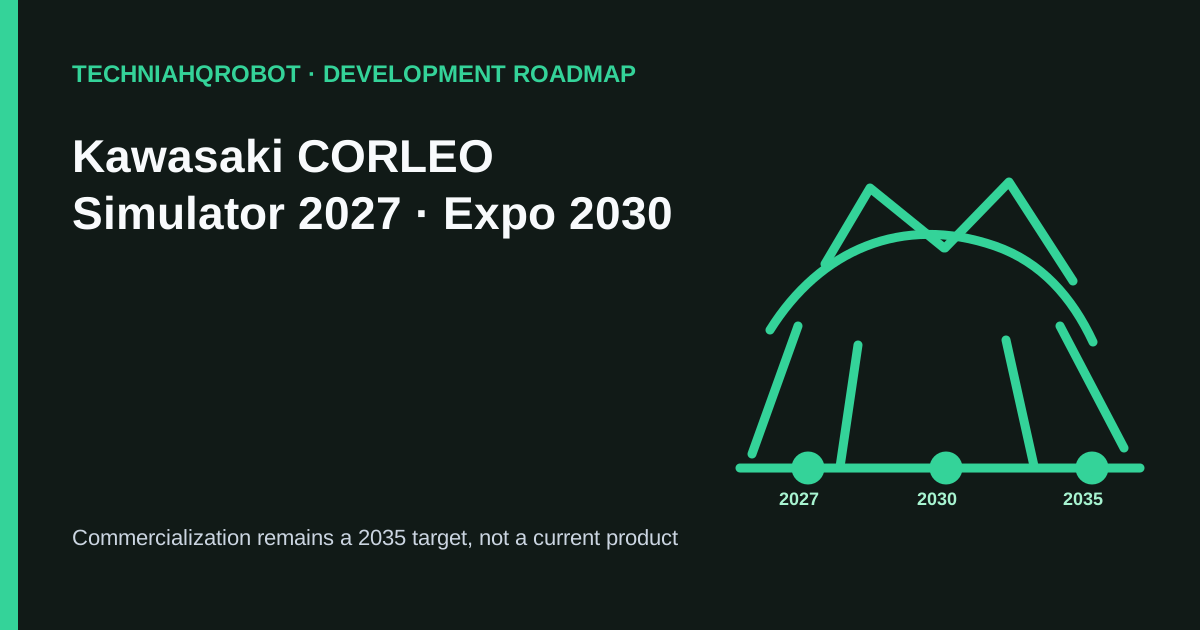
Kawasaki Heavy Industries has moved CORLEO from a distant 2050 concept into a formal development program. The company now targets a riding simulator in 2027, use as on-site mobility at Expo 2030 Riyadh and commercialization work toward 2035.
Kawasaki launched a dedicated SAFE ADVENTURE Business Development Team reporting directly to the company president.
The riding simulator targets completion in 2027 and is separate from a rideable physical CORLEO prototype.
Kawasaki targets CORLEO use as an on-site mobility vehicle at Expo 2030 Riyadh and says it is working toward commercialization in 2035.
The Expo 2025 exhibit was described by Kawasaki as a 2050 concept model that visitors could see striking poses, not as a demonstrated running vehicle.
Original X post
Open on XLoading the full X post…
The new announcement is a development commitment, not a product launch
Kawasaki announced in December 2025 that it had launched development toward commercialization and created a dedicated SAFE ADVENTURE Business Development Team. That is more concrete than the original 2050 vision because it assigns an organization and intermediate milestones.
The announcement does not publish a sale price, production quantity, walking speed, payload, range, stability test or completed rideable prototype. CORLEO should still be described as a concept under development rather than a product entering customer production.
The 2027 milestone is a riding simulator
Kawasaki says the simulator should enable people to experience four-legged mobility virtually. The company plans to reuse motion data and 3D models from CORLEO development and explore applications in gaming and e-sports.
A simulator can help engineers study rider input, body motion and comfort before a mature physical machine exists. It does not demonstrate that the real vehicle can balance a rider, recover from a misstep or traverse the terrain shown in promotional imagery.
Technical details
- Project
- CORLEO
- Developer
- Kawasaki Heavy Industries
- Current public status
- Concept model and active development program
- 2027 target
- Riding simulator completion
- 2030 target
- On-site mobility use at Expo 2030 Riyadh
- 2035 target
- Commercialization
- Intended control
- Rider body-weight shifts with machine assistance
- Proposed energy system
- Hydrogen engine generating electricity for the leg drives
Expo 2030 Riyadh is the first public operational target
The company targets use as an on-site mobility vehicle at Expo 2030 in Riyadh, Saudi Arabia. This wording is stronger than simply displaying a model, but Kawasaki has not yet released the operational conditions, rider access rules or number of machines planned for the event.
An expo deployment could range from a restricted demonstration course to supervised visitor transport. Until those conditions are published, it is premature to describe CORLEO as an unrestricted autonomous off-road robot.
The original Expo 2025 machine was presented as a poseable concept model
Kawasaki's April 2025 release called CORLEO a 2050 concept model and said visitors would see it striking different poses. The public material described intended capabilities such as shock absorption, weight-shift operation and travel over difficult terrain.
The dramatic footage of running across mountains communicated the design goal. It did not provide measured proof of a physical robot galloping with a rider. This distinction explains why there was little new hardware evidence immediately after the first reveal.
The proposed control system keeps the rider inside the loop
Kawasaki describes control through body-weight shifts, similar to horseback riding. The rear legs use a motorcycle-derived swingarm idea so they can move vertically relative to the front legs and absorb shocks while preserving the rider's forward view.
Machine assistance is planned to make difficult terrain safer, and a separate navigation concept would detect weather, temperature, road surface conditions and wildlife. None of this establishes autonomous destination planning or rider-free navigation.
Hydrogen is part of the concept, but the engineering numbers remain unpublished
The proposed system stores hydrogen in a rear-leg canister and uses a hydrogen engine in the front section to generate electricity for the leg drives. The architecture connects Kawasaki's hydrogen work with its motorcycle and industrial robotics experience.
Kawasaki has not published fuel capacity, conversion efficiency, runtime, thermal behavior, acoustic output or refueling requirements for a functioning CORLEO. Those figures will matter more than the fuel label when engineers evaluate weight, range and safety.
What would prove that CORLEO has crossed from concept to robot
The strongest evidence would be an uncut physical demonstration showing mounting, standing, walking, turning, stopping, slope traversal and recovery with a rider. The test should disclose terrain, speed, payload, external support, operator input and failures.
The roadmap makes CORLEO worth following because Kawasaki has attached dates and a dedicated team to the project. The machine remains technically unproven in public, and the next meaningful update is hardware evidence rather than another cinematic render.
Verification notes
- The 2027 target refers to a riding simulator, not completion of a physical rideable CORLEO.
- The Expo 2030 and 2035 dates are Kawasaki targets and are not treated as guaranteed deployment or sales dates.
- No autonomous-navigation capability, public running trial, price, speed, range or payload is claimed without published evidence.
Frequently asked questions
Is Kawasaki CORLEO a working robot?
Kawasaki has displayed a poseable concept model and launched a formal development program. It has not publicly demonstrated the full rideable running performance shown in promotional imagery.
When will Kawasaki CORLEO be released?
Kawasaki targets a riding simulator in 2027, on-site mobility use at Expo 2030 Riyadh and work toward commercialization in 2035. These are development targets, not guaranteed retail dates.
Is CORLEO autonomous?
The announced concept is rider-guided through body-weight shifts with machine assistance. Kawasaki has not published autonomous navigation or rider-free operation specifications.
Explore the technical topic
Share this article
Share the current TechniaHQRobot article page.
Sources
By @techniahqrobot
About the publication · Sources and editorial policy · Report a correction