
TurboVLA Runs Robot Control at 32 Hz Without a Giant LLM
The results show that a compact VLA can execute bounded manipulation tasks quickly, but they do not prove that large language models are unnecessary for planning, reasoning or open-world robotics.
By TechniaHQRobot
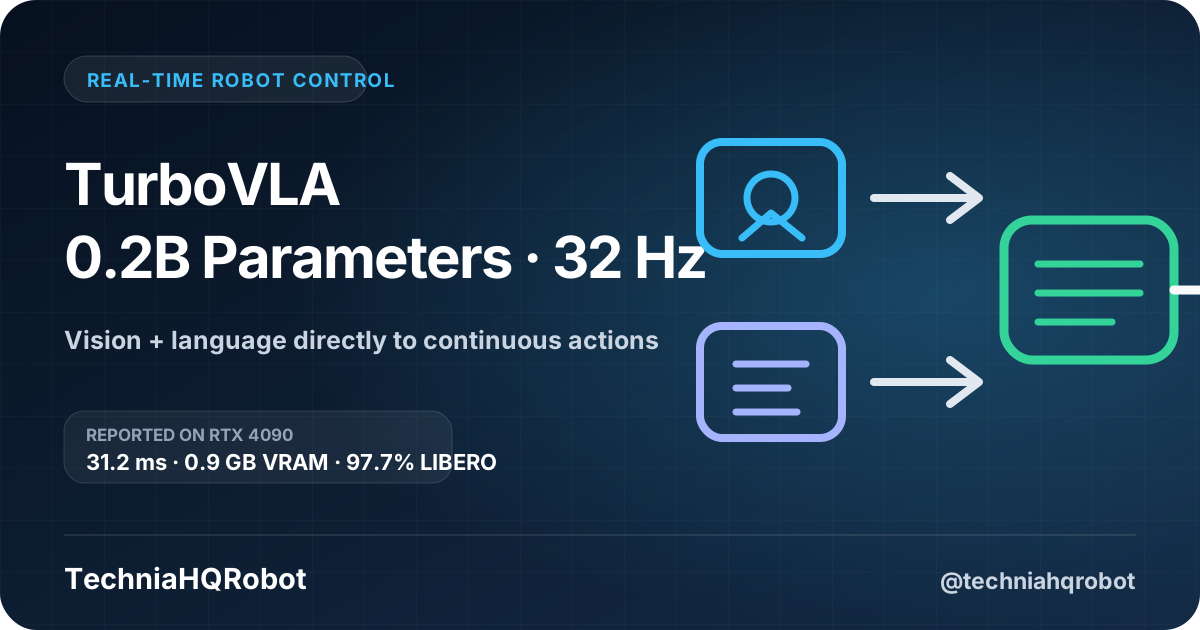
TurboVLA removes the large language model from the center of execution-level robot control. The preprint reports a compact 216-million-parameter policy that directly combines visual features and language instructions before predicting continuous action chunks.
The LIBERO version contains 216.1 million parameters, reported as 0.2B, and produced action chunks in 31.2 milliseconds on one RTX 4090.
The authors report 97.7% average success across 2,000 LIBERO trials and 60.2% across 50 clean RoboTwin 2.0 bimanual tasks.
On an AgileX Piper arm, four tasks were tested 40 times each after 65 teleoperated demonstrations per task.
The paper is an arXiv preprint. Code and benchmark checkpoints are public, but independent real-robot reproduction was not located at publication time.
Original X post
Open on XLoading the full X post…
TurboVLA removes the LLM from the execution path
Many vision-language-action systems route camera features and instructions through a multi-billion-parameter language model before generating robot actions. That design brings useful semantic knowledge, but the language backbone remains active every time the policy is queried, adding memory use and latency.
TurboVLA uses a more direct route. DINOv3 encodes the camera images, BERT encodes the instruction, and six bidirectional interaction layers exchange information between the two streams. An ACT-style decoder then predicts a chunk of continuous robot actions in one forward pass. The model still uses language; it avoids a large generative language model at the center of low-level execution.
What 32 Hz actually measures
The paper reports 31.2 milliseconds from receiving the multimodal observation to producing an action chunk on an NVIDIA RTX 4090 with batch size one. That corresponds to roughly 32 policy predictions per second. The comparison uses the authors’ implementations and official checkpoints for runnable baselines on the same GPU.
This is policy-inference frequency, not proof that every part of the robot operates at 32 Hz. Camera capture, network transport, safety checks, command execution and the arm’s lower-level servo controller add their own timing. The result still matters because a slow policy can leave the robot acting on stale visual information.
Technical details
- Model
- TurboVLA
- Developers
- Huazhong University of Science and Technology and Huawei Technologies
- Execution pathway
- Vision + language → continuous robot actions
- LIBERO model size
- 216.1M parameters (reported as 0.2B)
- Reported policy latency
- 31.2 ms on one NVIDIA RTX 4090
- Reported inference memory
- 0.9 GB VRAM
- Real robot
- AgileX Piper arm
- Public artifacts
- Apache-2.0 code; LIBERO and RoboTwin checkpoints with separate model-license terms
The LIBERO benchmark result combines speed and task success
TurboVLA was evaluated on the four LIBERO suites covering object, spatial, goal-conditioned and longer-horizon manipulation. The study used 50 rollouts for each of 40 tasks, producing 2,000 trials in total. The reported average success rate was 97.7%.
The 216.1-million-parameter configuration used 0.9 GB of inference VRAM and 31.2 milliseconds per policy call. In the paper’s same-hardware comparison, π0.5 reached 96.9% with 3.4 billion parameters, 12.8 GB of VRAM and 93.6 milliseconds of latency. These are benchmark results under the paper’s protocol, not a universal ranking across every robot and environment.
The real-robot study used four controlled tabletop tasks
The physical setup used an AgileX Piper arm with a wrist-view RGB-D camera and a third-view RGB-D camera. The four instructions were to grab a roller, move a playing card away, press a stapler and stack three bowls. The model was initialized from LIBERO pretraining and fine-tuned with 65 teleoperated demonstrations for each task.
Each task was evaluated over 40 trials. The paper reports success rates of 92.5% for grabbing the roller, 80% for moving the playing card, 90% for pressing the stapler and 87.5% for stacking three bowls. TurboVLA outperformed π0.5 under the same platform, data and evaluation protocol according to the authors.
Bimanual results use a larger TurboVLA configuration
For RoboTwin 2.0, the team trained one policy across 50 clean bimanual tasks. This version uses a DINOv3 ViT-L visual backbone, three camera views, 14-dimensional joint-position actions and a 50-step action chunk.
The bimanual configuration is reported at 0.4 billion parameters rather than 0.2 billion. It achieved 60.2% average success with 43.4 milliseconds of latency, compared with 57.0% for π0.5 and 50.3% for StarVLA-α in the paper’s clean-setting comparison. Randomized-scene data were excluded because of the authors’ compute budget.
Small execution models and robot foundation models solve different problems
TurboVLA is strong evidence that bounded execution does not always need a giant language model. A command such as “press the stapler” already defines the task. The controller mainly needs to locate the object, estimate the scene and generate a stable movement.
High-level planning is different. A household robot asked to clean an unfamiliar room may need to interpret an ambiguous request, decompose it into steps, choose tools and recover from unexpected conditions. The authors explicitly state that TurboVLA is designed for concrete execution-level instructions and may lack the semantic reasoning required for high-level task planning. This is why parameter count alone does not decide whether a system qualifies as a broad robot foundation model.
The ablation study shows language still matters
Removing language reduced the reported LIBERO average from 97.7% to 70.8%. The largest collapse occurred in goal-conditioned tasks, where success fell from 97.4% to 11.6%. A learned task-ID embedding recovered much of the performance but remained below natural-language conditioning.
The text encoder did not need to be a giant generative model. T5-Small reached 97.1%, while the chosen BERT setup reached 97.7%. Bidirectional interaction between vision and language also performed better than simple concatenation or one-way attention in the reported ablations.
What is public and what remains unproven
The official repository publishes training and evaluation code under Apache-2.0. The team also released LIBERO and RoboTwin checkpoints with normalization files and checksums. The checkpoints include DINOv3-derived parameters and are distributed under additional DINOv3 terms, so the code license does not describe every released weight.
The evidence remains a first-version preprint and author-run evaluation. The real-world tasks are controlled tabletop experiments on one arm, with 160 trials in total. The paper does not establish long-duration reliability, unseen-home performance, safety around people, operation on embedded robot compute or independent reproduction of the physical trials.
Verification notes
- TurboVLA is an arXiv v1 preprint dated July 29, 2026; the results are author-reported.
- The 32 Hz figure refers to 31.2 ms policy inference on an RTX 4090, not the complete robot servo loop or an embedded computer.
- The four physical-task success rates are based on 40 trials per task after 65 teleoperated demonstrations per task.
- The 0.2B figure describes the LIBERO configuration. The RoboTwin bimanual configuration is reported at 0.4B parameters.
- The code is Apache-2.0, while released checkpoints also contain DINOv3-derived parameters governed by separate terms.
Frequently asked questions
Does TurboVLA use no language model at all?
TurboVLA uses a lightweight BERT text encoder for instructions. It removes a large generative language model from the center of execution-level action prediction.
Is TurboVLA really running at 32 Hz?
The paper reports 31.2 ms policy latency on one RTX 4090, equivalent to about 32 action-chunk predictions per second. This does not include every sensor, network and low-level control delay in a complete robot.
What robot was used in the physical tests?
The real-world study used an AgileX Piper arm with wrist-view and third-view RGB-D cameras.
Is TurboVLA a robot foundation model?
It is a VLA policy with LIBERO pretraining and transfer to a Piper arm, but the paper focuses on efficient execution. Broader foundation-model status requires evidence across more tasks, environments and robot embodiments.
Explore the technical topic
Share this article
Share the current TechniaHQRobot article page.
Sources
By @techniahqrobot
About the publication · Sources and editorial policy · Report a correction